Taihuai First, Peaks Later: How to See Wutai Shan in Two Days
Wutai Shan's entry ticket (listed at 135 yuan full) now covers the day of use and the next day with unlimited re-entry; sleep in Taihuai, walk the core temples on day one and climb Dailuoding on day two, booking ahead on the official WeChat account.
Published
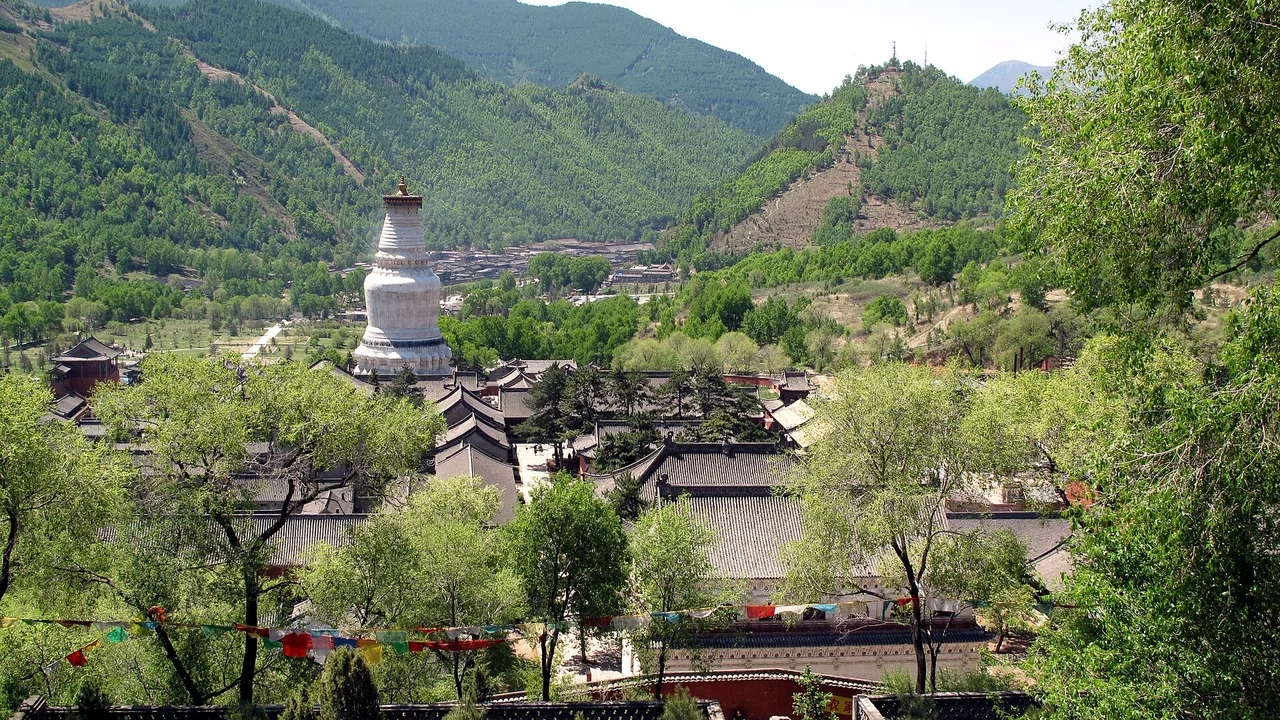
See Wutai Shan (五台山) from Taihuai town (台怀镇), the valley at its centre. Book the entry ticket on the official WeChat account. It is listed at 135 yuan full price and, since August 2026, it is valid on the day you use it and the next day, with unlimited re-entry. Spend day one on the core temples and day two on Dailuoding.
What is Wutai Shan, and where do you actually go?
Wutai Shan is one of China's four sacred Buddhist mountains and is associated with Manjushri (文殊), the bodhisattva of wisdom. It is not one summit. Five flat-topped terrace peaks ring a high valley, and dozens of active monasteries crowd that valley around Taihuai town. Most visitors never go higher than the valley, and for a first visit that is fine. The five terrace peaks are a separate decision.
Which temples should you prioritise?
These are all walkable from central Taihuai:
- Tayuan Temple (塔院寺). The big white stupa that appears in every photograph. Walk round it clockwise with the pilgrims.
- Xiantong Temple (显通寺). It is described as the oldest foundation on the mountain. Look for the small bronze hall at the back.
- Pusading (菩萨顶). A former imperial monastery reached by a long stairway. It has yellow-glazed roofs and the best view down over Taihuai.
- Wuye Temple (五爷庙). Small, smoky and the busiest temple on the mountain. Go early to see it at its most intense, or skip it if crowds bother you.
- Shuxiang Temple (殊像寺). This hall holds the mountain's largest Manjushri image. It is a little south of the centre and quieter.
That is a full, unhurried first day. More temples will not add much once the halls start to blur.
How do you do Dailuoding?
Dailuoding (黛螺顶) sits on the ridge east of town. Its hall gathers the five Manjushri forms of the five terraces, which is why pilgrims call it the "small pilgrimage" (小朝台). You can climb the stairway, which visitor guides put at about 1,080 steps, or take the cable car. Go on the morning of day two, before the afternoon cloud builds.
How do the ticket and reservation work?
Checked October 2026 (Asia/Shanghai). The Wutai Shan management committee and its WeChat account “五台山游客服务中心” win over this page and every app.
Ticket. The management committee lists 135 yuan full and 70 yuan half price. Some listings give a lower off-season price. From 1 August 2026 a ticket is valid on the day of use and the following day, with unlimited entries in that window. Book on the WeChat account up to five days ahead (today plus the next four). Each booking has a time slot, and there is a daily cap. Entry is by ID or QR code. Foreign visitors should book with their passport details and carry the passport.
Inside the valley. A sightseeing bus pass is listed at 50 yuan for four days of unlimited rides. Some individual temples charge small extra fees, and a few take cash only, so carry some small notes.
Hours. Temples keep their own hours. Valley temples generally open early and close around dusk, and the hours are shorter in winter.
What should you know about conduct and weather?
These are working monasteries. Dress modestly, keep your voice down, do not point at images, and ask before photographing monks or the inside of halls. Taihuai lies at a high altitude, so even in summer evenings are cool. By late October nights drop below freezing. Bring a warm layer whatever the forecast says.
Where should you sleep?
Sleep in Taihuai, within walking distance of the temples. The early morning, when bells and chanting start and the day-trippers have not yet arrived, is the best part of a visit. Rooms are tight in summer and on holidays. Getting there is covered in transport. The three-day plan adds the Tang temples on the way out.
Cover photo: G41rn8 / Wikimedia Commons (CC BY-SA 4.0)
More from Xinzhou
- nature / 4 min readThe 'grand pilgrimage' to Wutai Shan's five terrace peaks — Beitai is about 3,061 m — takes a full day by official vehicle; do it in July to September, carry winter layers, and skip it from mid-October when snow and wind close the tops.
- history / 4 min readFoguang Temple's East Hall (857) is China's most celebrated surviving Tang timber building; tickets about 40 yuan, Tuesday–Sunday with Monday closure since 1 September 2026 — time your visit to a free guided talk and allow travel time from Wutai Shan or Taiyuan.
- history / 4 min readNanchan Temple's main hall (782) is the oldest dated timber building in China — small, plain and quiet; tickets about 20 yuan in season and 10 off-season, Monday closed since September 2026, best paired with Foguang on one drive.