Older and Smaller: Nanchan Temple, China's Earliest Dated Timber Hall
Nanchan Temple's main hall (782) is the oldest dated timber building in China — small, plain and quiet; tickets about 20 yuan in season and 10 off-season, Monday closed since September 2026, best paired with Foguang on one drive.
Published
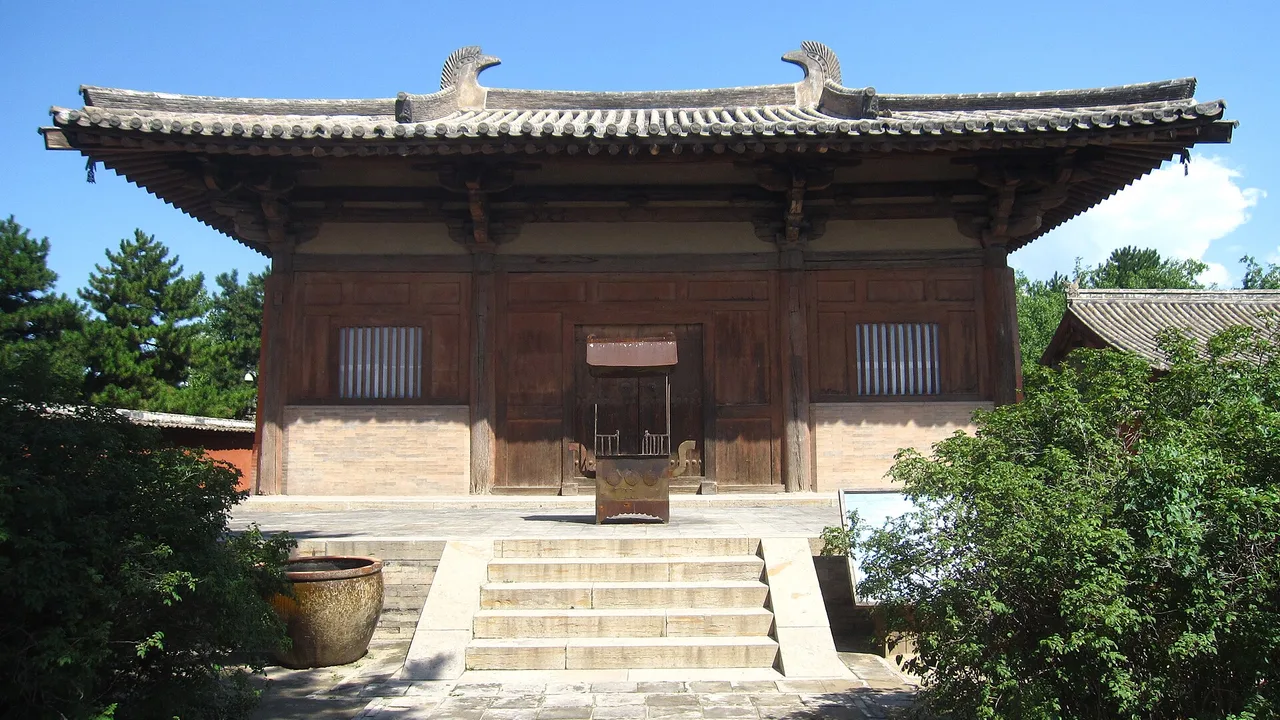
Add Nanchan Temple (南禅寺) to Foguang if you can. Its main hall, built in 782, is the oldest dated timber building in China. It is small and plain, and half an hour covers it. Tickets are listed at about 20 yuan in season and 10 yuan off-season. Since September 2026 it has been closed on Mondays, like Foguang.
Why is it older than Foguang but less famous?
Nanchan's main hall was identified only in the 1950s, after Foguang had already become the famous Tang survivor. A beam inscription dates it to 782, seventy-five years before Foguang's East Hall. It survived the great persecution of Buddhism in 845 probably because it was a small village temple that nobody bothered to destroy.
It is a three-bay hall with a single low hip-and-gable roof. There is no great platform and no grand approach. Foguang impresses you. Nanchan makes you lean in and look closely.
What should you look at?
The roof line. The pitch is very shallow and the eaves stretch wide over modest walls. Compare it in your head with the steep Ming and Qing roofs you see everywhere else.
The brackets. They are simple and widely spaced, with no intermediate sets between the columns. This is the plainest Tang structure there is.
The sculpture. The main hall holds a group of Tang painted clay figures on a U-shaped altar. Look at the full faces and draped robes, and at the attendant bodhisattvas. Photography inside has been restricted. Respect the barriers.
Join one of the free talks if your timing works. The schedule relayed from last year's off-season notice lists two a day, at 10:10 and 15:30.
How should you pair it with Foguang?
Both temples are in Wutai county south-west of the mountain, a drive apart. See Foguang first, when your attention is fresh and a talk fits your timing, then Nanchan on the way to Taiyuan. Or reverse the order if you are heading up to Wutai Shan. Either way, hire a car for the day. No bus links the two in a way a visitor can rely on.
If you only have time for one, choose Foguang for the full experience. Choose Nanchan only if being able to say you have seen the oldest one matters to you.
Tickets, hours and phone
Checked October 2026 (Asia/Shanghai). On-site notices and the temple's official channels win. No stable official web page was found. The details below come from listings and relays of official notices.
Ticket. About 20 yuan (April–October) and 10 yuan (November–March). Students and seniors are listed at half price, and children under 1.2 m enter free. Paper souvenir tickets were still being issued in August 2026.
Hours. Listed as 8:30–17:30 (last entry 17:00) from April to October and 8:30–17:00 (last entry 16:30) from November to March. Closed Mondays from 1 September 2026. If a public holiday falls on a Monday, phone to check.
Phone. 0350-6525162.
Who should skip it?
Anyone tired of temples, or anyone visiting on a Monday. Everyone else can spare 30 minutes for the oldest dated timber building in China. The three-day plan pairs it with Foguang on the exit day.
Cover photo: Zeus1234 / Wikimedia Commons (CC BY-SA 3.0)
More from Xinzhou
- culture / 4 min readWutai Shan's entry ticket (listed at 135 yuan full) now covers the day of use and the next day with unlimited re-entry; sleep in Taihuai, walk the core temples on day one and climb Dailuoding on day two, booking ahead on the official WeChat account.
- nature / 4 min readThe 'grand pilgrimage' to Wutai Shan's five terrace peaks — Beitai is about 3,061 m — takes a full day by official vehicle; do it in July to September, carry winter layers, and skip it from mid-October when snow and wind close the tops.
- history / 4 min readFoguang Temple's East Hall (857) is China's most celebrated surviving Tang timber building; tickets about 40 yuan, Tuesday–Sunday with Monday closure since 1 September 2026 — time your visit to a free guided talk and allow travel time from Wutai Shan or Taiyuan.