Hanging Sculpture and Yuan Walls: Which Fenyang Temples Are Worth the Detour?
Fenyang's three painted-temple stops are Taifu Temple for Ming hanging sculpture, Tiancun Houtu Temple for gilded Ming murals and Beiyuyuan Wuyue Temple for faded Yuan murals; go to Taifu first, check its midday closure, and treat the other two as caretaker-dependent.
Published
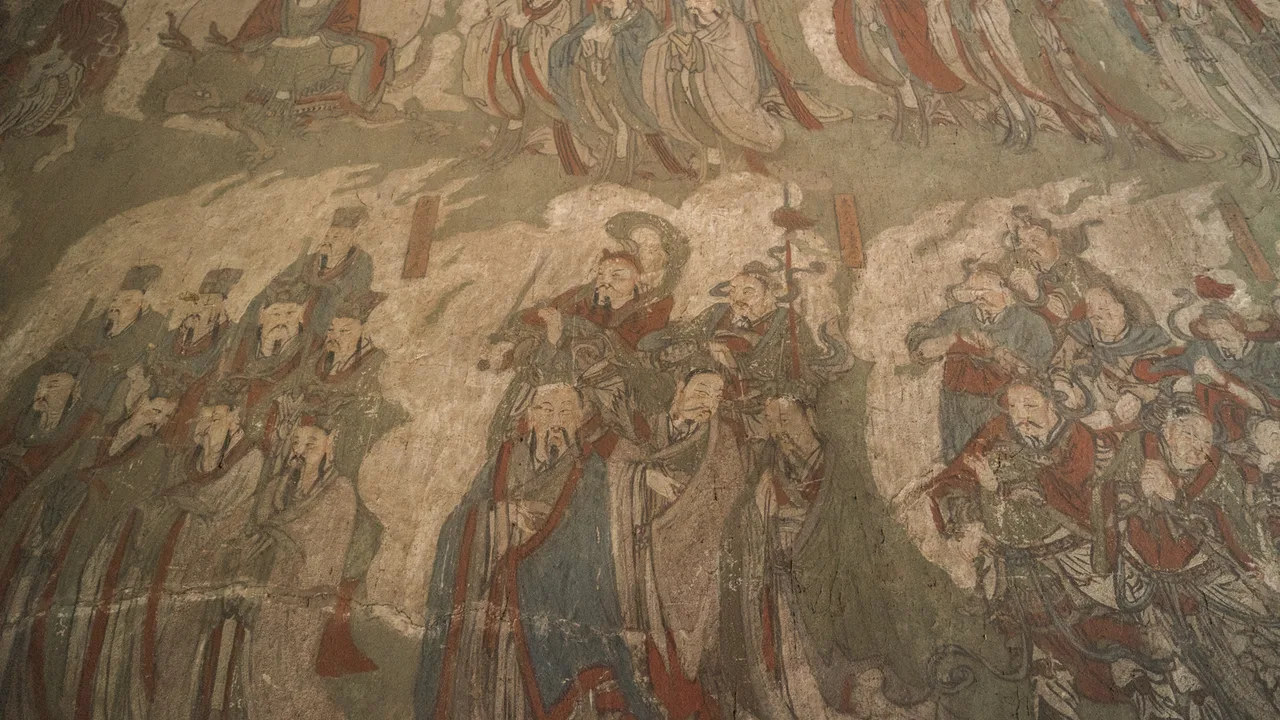
Fenyang has three painted-temple stops worth knowing. Taifu Temple (太符观) has Ming hanging sculpture. Tiancun's Houtu Temple (后土圣母庙) has gilded Ming murals. Beiyuyuan's Wuyue Temple (五岳庙) has faded Yuan wall paintings. Start with Taifu, check its midday closure, and treat the other two as depending on whether the caretaker is in.
Why come to Fenyang for temples at all?
Shanxi holds more surviving pre-modern temple painting than any other province. Most travellers see it at Yongle Palace in the far south or in Datong's Huayan and Shanhua temples. Fenyang, on the plain below the Lüliang Mountains, has a small cluster of village temples that few foreign visitors reach. You get close-up looks, no crowds, and the odd sense of finding something by yourself.
Taifu Temple: the one to prioritise
A Daoist temple in Shangmiao village (上庙村) near Xinghuacun, and a national key protected site. The main hall to the Jade Emperor is a Jin-dynasty structure with clay figures to match. The real draw is the side halls. Their walls are covered in Ming xuansu (悬塑), "hanging sculpture": hundreds of small modelled figures, horsemen, clouds and palace façades, built out from the wall surface in procession scenes of the Five Peaks and the Four Rivers, and of the Houtu goddesses. If you have seen Shuanglin near Pingyao, this is the same family of craft at a more intimate scale.
Visitor reports from 2025–2026 say entry is free with ID registration, the temple closes on Mondays, and it shuts for a long midday break (roughly 11:30–15:00). These hours are not official, so check before you go.
Tiancun Houtu Temple: murals for the patient
A few kilometres north-west of Fenyang town, in Tiancun (田村). Only the main hall survives. It is the Lüliang government's own heritage write-up that matters here: the east, west and north walls carry about 75 square metres of Ming painting, with banquet, welcome and procession scenes in heavy colour and raised gilding. It is a provincial-level protected site rather than a national one, and it is small. Go if you liked Taifu and want flat painting rather than sculpture.
Beiyuyuan Wuyue Temple: for the committed
In Beiyuyuan village (北榆苑村), Sanquan town, about 15 km south-west of Fenyang. It is a national key site with two Yuan halls. The Five Peaks Hall has about 40 square metres of Yuan murals of processions and court ladies, and the Water Immortal Hall keeps fragments of a water-god procession signed by local painters. The paintings are damaged and were retouched in later centuries. The architecture matters as much as the walls: four halls stand in a row facing one opera stage. Travellers report the halls are often locked and that you may need to contact the site caretaker. Don't come here unless you have a car and some flexibility.
Practical: what should you check?
Checked October 2026 (Asia/Shanghai). No official visitor pages were found for these three temples. Everything below comes from government heritage descriptions plus traveller reports, so posted notices and the local heritage office win.
- Entry: generally reported free, with ID registration at Taifu. Carry your passport.
- Hours: Taifu reportedly closed Mondays and at midday. The other two are caretaker-dependent.
- Photography: flash is banned in all three. Some halls ban photos outright. Bring a small torch for dark walls.
- Transport: taxi or hired car from Fenyang. Village buses are infrequent.
How do these pair?
Taifu plus the Fenjiu distillery is a natural half day, since the two are close together. Add Houtu if you still have energy. Wuyue is a separate excursion. All of it fits in the three-day Lüliang plan.
Cover photo: Fymking / Wikimedia Commons (CC BY-SA 4.0)
More from Lüliang
- history / 6 min readQikou's old trading street and river landing are free and open all day; give it three to five hours, climb to Heilong Temple for the bend in the Yellow River, and sleep over if you want Lijiashan at dawn.
- culture / 5 min readLijiashan is a free, still-lived-in cave-dwelling village a few kilometres from Qikou; go early or late for the light, allow two to three hours, and expect steep stone lanes rather than a staged attraction.
- food / 5 min readThe Fenjiu Culture Scenic Area at Xinghuacun, about 15 km from Fenyang, is a working distillery tour — museum, fermentation halls, old cellars and a tasting — for a 42-yuan ticket; budget two to three hours and do not drive afterwards.