Eleven Tiers of Caves: Is Lijiashan Worth the Climb from Qikou?
Lijiashan is a free, still-lived-in cave-dwelling village a few kilometres from Qikou; go early or late for the light, allow two to three hours, and expect steep stone lanes rather than a staged attraction.
Published
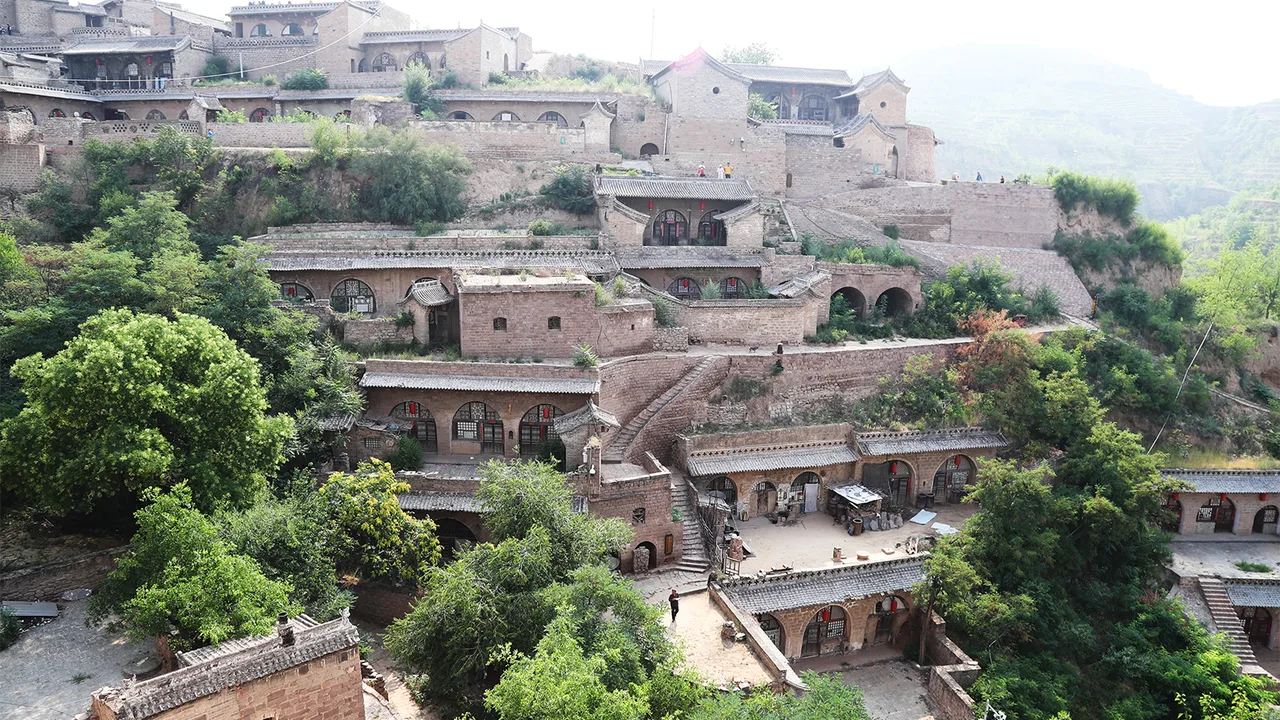
Yes, if you are already in Qikou. Lijiashan (李家山村) is a cave-dwelling village stacked up a steep loess gully a few kilometres from town. It is free to enter and people still live there. Allow two to three hours. Go early or late in the day, and wear shoes that grip on steep stone.
What makes Lijiashan different from other cave villages?
Plenty of villages on the Loess Plateau live in yaodong (窑洞), arched rooms dug into hillsides or built of stone against them. What sets Lijiashan apart is the stacking. The caves rise in tier after tier up both sides of a narrow ravine, so from the opposite slope the village looks like one building. Chinese visitors often call it the "Potala of the Loess Plateau". Guides commonly count eleven tiers. The two big compounds, the East and West Landlord Courtyards (东财主院 / 西财主院), were built by families who did well in the Qikou trade. They show a stone-and-brick standard well above an ordinary farmhouse.
The painter Wu Guanzhong (吴冠中) sketched here in the late 1980s and praised the place in print. Since then it has drawn art students. On a weekday you will often find easels set up in the lanes.
How do you see it in two or three hours?
- Viewpoint first. Start at the viewpoint across the gully from the village. This is the stacked view, and it is clearest in low sun.
- Up the main lane. Walk in and climb slowly. The lanes are stone, steep and uneven.
- The landlord courtyards. The West Courtyard has a small entry charge (guides cite 2 yuan). It is worth it for the two-storey cave layout.
- Back the way you came, or down through side lanes if your knees allow.
Ask before photographing people at their doors. This is a village, not a museum, and the older residents have had a lot of cameras pointed at them.
How do you get there from Qikou?
Recent guides put the village roughly 3–5 km from Qikou by road, about 10–15 minutes by car. Most visitors without a car hire a local driver from Qikou for a return trip with waiting time. Agree the price before you set off; August 2026 guides quote around 50–60 yuan. Fit walkers can do it on foot in under an hour, though it is uphill and exposed in summer. Guides report that on busy holidays private cars may be stopped outside and visitors sent up by shuttle. Follow the signs on the day.
What should you check before you go?
Checked October 2026 (Asia/Shanghai). Posted notices at the village and from the Qikou scenic area win.
- Entry: free; small charge for the West Landlord Courtyard. (Visitor guides, August 2026; no official ticket page found. Treat this as provisional.)
- Hours: open village, no fixed hours. Courtyard interiors keep daylight hours.
- Facilities: a few family restaurants and cave inns. Some take cash only, and recent guides say there is no ATM, so bring cash from Lin County or Qikou.
- Access: steep lanes with no step-free route. It is hard going with a pram or limited mobility.
Should you sleep in Lijiashan or Qikou?
Sleep in Lijiashan only if photography is the point. Waking up there gives you the first and last light, but food and transport are thinner. For most people, Qikou is the easier base with a morning trip up. See Qikou in half a day and the three-day plan.
Cover photo: CGTN
More from Lüliang
- history / 6 min readQikou's old trading street and river landing are free and open all day; give it three to five hours, climb to Heilong Temple for the bend in the Yellow River, and sleep over if you want Lijiashan at dawn.
- food / 5 min readThe Fenjiu Culture Scenic Area at Xinghuacun, about 15 km from Fenyang, is a working distillery tour — museum, fermentation halls, old cellars and a tasting — for a 42-yuan ticket; budget two to three hours and do not drive afterwards.
- history / 6 min readFenyang's three painted-temple stops are Taifu Temple for Ming hanging sculpture, Tiancun Houtu Temple for gilded Ming murals and Beiyuyuan Wuyue Temple for faded Yuan murals; go to Taifu first, check its midday closure, and treat the other two as caretaker-dependent.