Five Hundred Figures in One Small Hall: Seeing Changzhi Guanyin Hall's Hanging Sculptures
Changzhi Guanyin Hall is a Ming hall on the city's edge packed with about 500 painted clay figures hung on walls and beams; it closed for maintenance in June 2026, so confirm it is open before you go.
Published
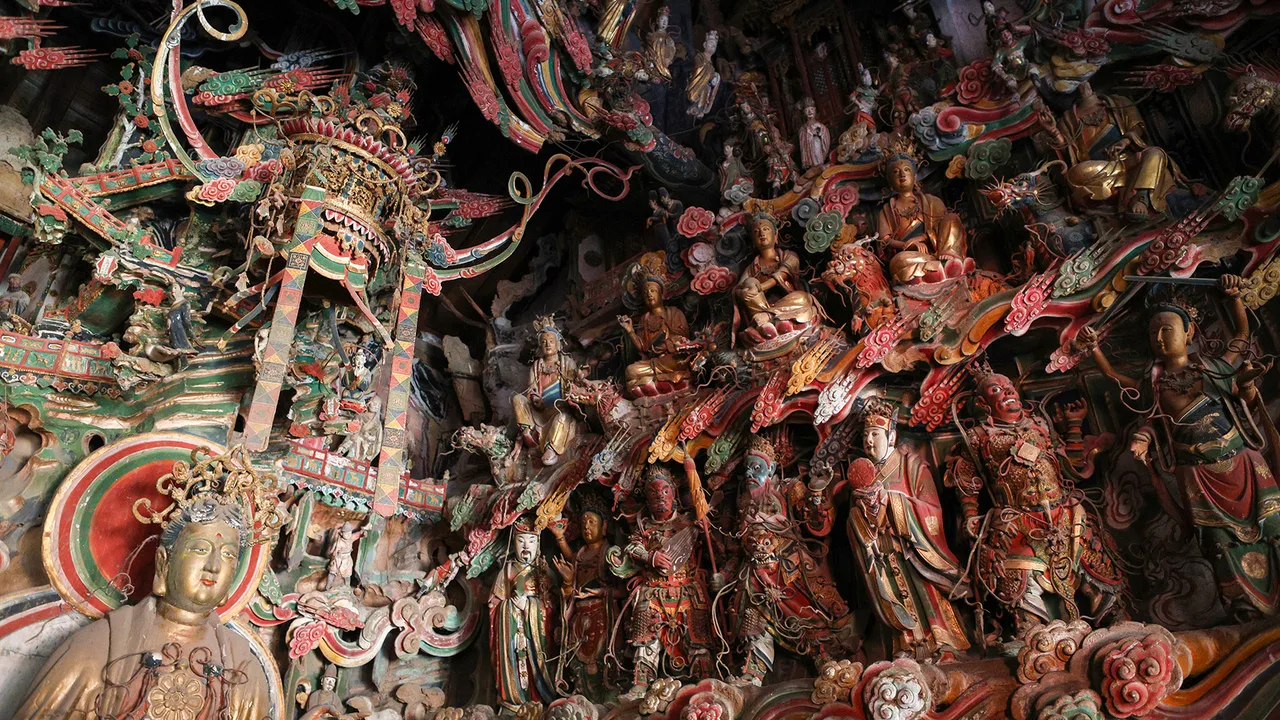
Changzhi Guanyin Hall (长治观音堂) is a small Ming temple on the southern edge of Changzhi whose main hall is filled, floor to rafters, with about 500 painted clay figures hung from the walls and beams. It closed for maintenance on 17 June 2026. Reports from late September show visitors inside again, but call before you go.
What makes the hall worth the trip?
The building is modest. The inside is not. The hall dates to the ninth year of the Wanli reign (1581), and the Shanxi Daily's October 2026 report counts around 500 figures in a room you can cross in a few steps. Some stand on the altar. Most are mounted on wooden armatures fixed to the walls, so they lean out over you at different angles. The technique is called hanging sculpture (悬塑). It gives a flat wall depth, and from the middle of the floor the whole room seems to tilt inward.
The subject is also unusual. Guanyin, Manjushri and Samantabhadra sit at the centre. Above them, on painted clouds, sit Confucius, the Buddha and Laozi together, the Ming idea that the three teachings are one. Around them are the eighteen arhats, the twenty-four devas and the twelve bodhisattvas of perfect enlightenment. The largest figures are about two metres tall. The smallest are about two centimetres. Guides like to point to a carved scene of the Eight Immortals with one missing; the local story says Zhang Guolao, said to be a Changzhi man, has gone home to visit family.
Is it actually open right now?
This is the question to settle first. On 17 June 2026 the hall's heritage office posted a notice that it was closing for maintenance, with reopening "to be announced". Through the summer travellers kept arriving at a locked gate. A traveller roundup dated 26 September still said no date had been given. Then on 28 September a Shanxi Daily reporter toured the hall with a guide and other visitors, which suggests it had reopened by the National Day holiday.
So treat it as probably open, not certainly open. Checked October 2026 (Asia/Shanghai). Call the hall on +86 355 3880990 (the number listed on Trip.com) or check the operator's WeChat notices the day before. Official notices win over anything here, including our reading of the reopening.
What does a visit cost and how long does it take?
Before the closure the ticket was widely reported at about 10 yuan, bought at the gate. We could not confirm the post-reopening price or hours from an official page, so do not plan around a specific number. Most visitors spend one to two hours, most of it in the one hall. A paid guide at the gate is worth it if you read some Chinese or bring a translation app, because the figures are arranged as stories and they are hard to decode cold.
Inside, flash, torches and touching are not allowed. The hall is dim. Several visitors suggest a sunny early afternoon, when side light comes through the lattice windows and the colours show best. In busy periods staff have let people in in small batches, so a weekday morning is calmer.
How do you get there?
The hall is in Liangjiazhuang (梁家庄), Luzhou District, inside the city's southern sprawl rather than out in the countryside. From the city centre or Changzhi East high-speed station a taxi takes roughly a quarter of an hour, depending on traffic. Show the driver 长治观音堂. Do not confuse it with other Guanyin halls in the area. Zhangzi county has its own 观音堂 at Xiyao village, which is a different site.
Is this the Black Myth: Wukong temple?
Guanyin Hall is often cited online as one of the Shanxi buildings behind Black Myth: Wukong, and gamers do come for it. The stronger, better documented game links in Changzhi are Chongqing Temple and Faxing Temple in Zhangzi county (see Chongqing and Faxing temples and the Black Myth route). Come here for the sculpture. If you have seen the Hanging Temple near Datong, note that the name is a coincidence of translation. That one is a cliff building; here the figures hang, not the hall.
How does it fit into a day?
Because it is in town, the hall works as a half-day on your arrival or departure day. Pair it with lunch in the centre and an afternoon drive to Zhangzi, or slot it into the three-day Changzhi plan. If it turns out to be shut, swap in Faxing Temple, whose Song figures are the closest substitute in the region.
Cover photo: Windmemories / Wikimedia Commons (CC BY-SA 4.0)
More from Changzhi
- history / 5 min readChongqing Temple and Faxing Temple in Zhangzi county are two small hillside temples south-west of Changzhi with outstanding Song painted sculpture, both linked to Black Myth: Wukong; see them together in half a day by car.
- history / 5 min readAlong the Zhuozhang River in Pingshun and Lucheng, a string of tiny Tang to Song timber temples sits 10 to 20 minutes apart; a seven-day joint pass started in October 2026, but go by car and expect some caretaker phone calls.
- nature / 5 min readThe Taihang Grand Canyon in Huguan county bundles Baquanxia, Hongdouxia and Qinglongxia on one 100-yuan, two-day ticket; first-gate entry is free from 15 October to 30 November 2026, but buses, boats and cableways still cost extra.