Arhats on the Hill, a Tang Stone Pagoda Below: Chongqing and Faxing Temples in Zhangzi
Chongqing Temple and Faxing Temple in Zhangzi county are two small hillside temples south-west of Changzhi with outstanding Song painted sculpture, both linked to Black Myth: Wukong; see them together in half a day by car.
Published
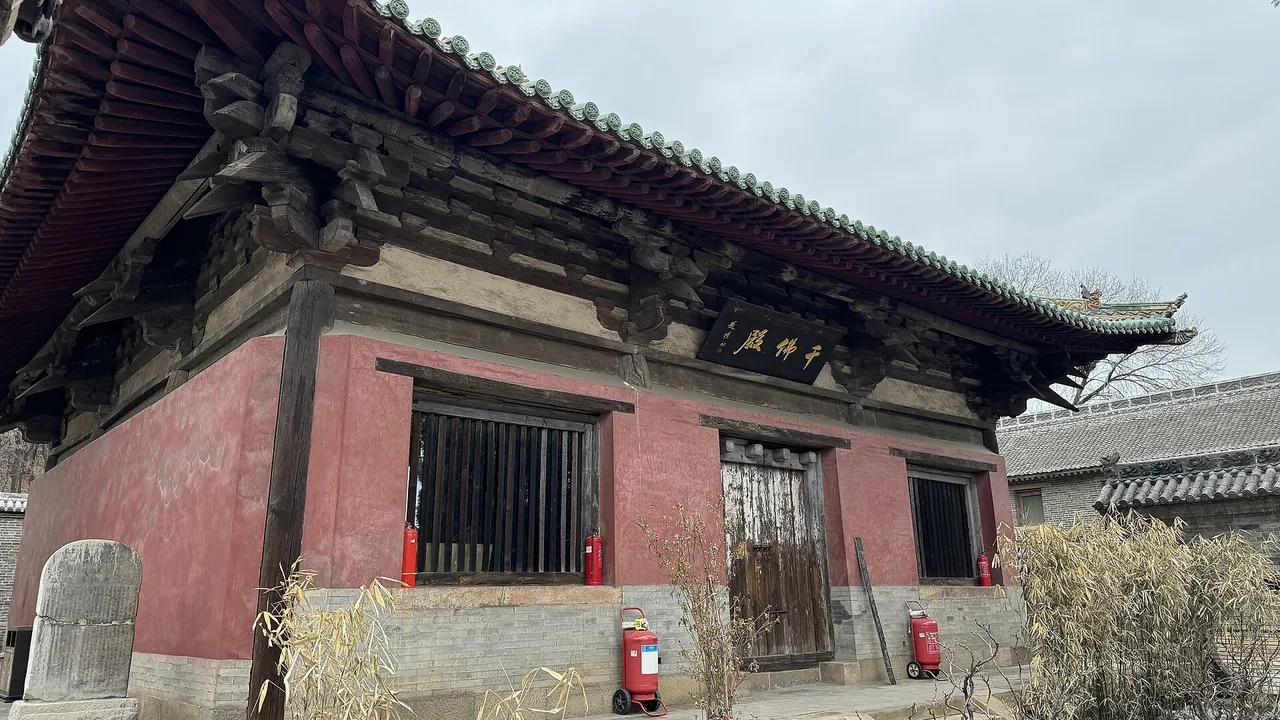
Chongqing Temple (崇庆寺) and Faxing Temple (法兴寺) are two small hillside temples in Zhangzi county, south-west of Changzhi, and both are known for painted sculpture from the Song dynasty. Both are linked to Black Myth: Wukong. With a car you can see the pair comfortably in half a day. By bus it takes most of a day.
Why do people come to Chongqing Temple?
Chongqing Temple sits alone on the south slope of Ziyun Hill above Ju village, with pines around it and very little else. The main Thousand Buddha Hall is a Song building. The draw is the side hall of the Three Bodhisattvas, where eighteen arhats line the walls. Secondary sources date them to 1079. They are not stiff rows of saints but individual men, thin, heavy, amused, cross, with drapery that still looks soft. Across the courtyard the Hall of the Ten Kings of Hell has later, Ming-period figures of the underworld judges, which are vivid in a different, darker way.
The game is the reason the temple got busy. Changzhi's transport bureau named Chongqing and Faxing as Black Myth: Wukong locations in September 2024 and improved road signs for the crowds. Zhangzi gets far fewer visitors than the famous Datong sites. Arrive away from the late-morning peak and you may have the arhats to yourself.
What is special about Faxing Temple?
Faxing Temple now stands on Cuiyun Hill near Cuizhuang in Cilin town (慈林镇), away from its original site in a fold of Cilin Hill. The county still calls it the oldest and most complete temple group in the Changzhi area. Locals talk about its "three treasures." The first is a Tang stone sarira pagoda, which secondary sources date to 673 and which looks half pagoda, half small stone hall. The second is a slender Tang lamp pillar dated 773. The third, and the reason to go, is the set of twelve bodhisattvas of perfect enlightenment in the Yuanjue Hall, usually dated to 1111. They are relaxed, full-faced and gently coloured, and art historians often rank them among the finest Song bodhisattvas anywhere.
If Chongqing gives you character, Faxing gives you calm. They are different enough that seeing both does not feel repetitive.
What do tickets and hours look like?
Checked October 2026 (Asia/Shanghai). These are small sites with thin official information, and listings disagree, so read these as ranges. Official notices and the gate win.
- Chongqing Temple: listings show 09:00–17:00 and a ticket of about 20 yuan. Qunar lists the site phone as 0355-8332001.
- Faxing Temple: Qunar lists 08:30–17:30 from April to October and 09:00–17:00 from November to March. Ticket figures vary between listings, from 5 to 20 yuan. Phone 0355-7731892. The temple closed briefly for repairs in summer 2026, so a call ahead is sensible.
Allow an hour at Chongqing and one to two at Faxing. The halls are dim, so give your eyes time to adjust before deciding there is nothing to see.
How do you get there without a car?
Zhangzi county has a tourist bus line, 802, from Zhangzi bus station via Jiulianhuan to Chongqing Temple. When the county launched it in early 2025, it ran hourly from 08:00 to 17:00 for 2 yuan. Faxing lies near the same corridor at Cuizhuang. First get from Changzhi to Zhangzi town by intercity bus or taxi. Bus timetables change, so ask at Zhangzi bus station. A hired car or ride-hailing driver for the half-day loop from Changzhi is simpler, and most visitors do it that way.
How should you combine them?
Do Faxing first in the morning, then continue to Chongqing, where light in the arhat hall is decent around midday. Back in Changzhi by mid-afternoon, you still have time for Guanyin Hall if it is open. For how these fit with the other game sites, see the Black Myth route. For a full sequence, see the three-day plan.
Cover photo: Patrick20242023 / Wikimedia Commons (CC BY-SA 4.0)
More from Changzhi
- history / 6 min readChangzhi Guanyin Hall is a Ming hall on the city's edge packed with about 500 painted clay figures hung on walls and beams; it closed for maintenance in June 2026, so confirm it is open before you go.
- history / 5 min readAlong the Zhuozhang River in Pingshun and Lucheng, a string of tiny Tang to Song timber temples sits 10 to 20 minutes apart; a seven-day joint pass started in October 2026, but go by car and expect some caretaker phone calls.
- nature / 5 min readThe Taihang Grand Canyon in Huguan county bundles Baquanxia, Hongdouxia and Qinglongxia on one 100-yuan, two-day ticket; first-gate entry is free from 15 October to 30 November 2026, but buses, boats and cableways still cost extra.