The Romance of the Western Chamber, on a Ridge: Pujiu Temple and the Puzhou Side of Yongji
Pujiu Temple near Puzhou, Yongji, is the setting of the Romance of the Western Chamber, a rebuilt temple around an old pagoda; 60/50 yuan seasonal, about 1.5 hours, best paired with Stork Tower nearby rather than as a stand-alone trip.
Published
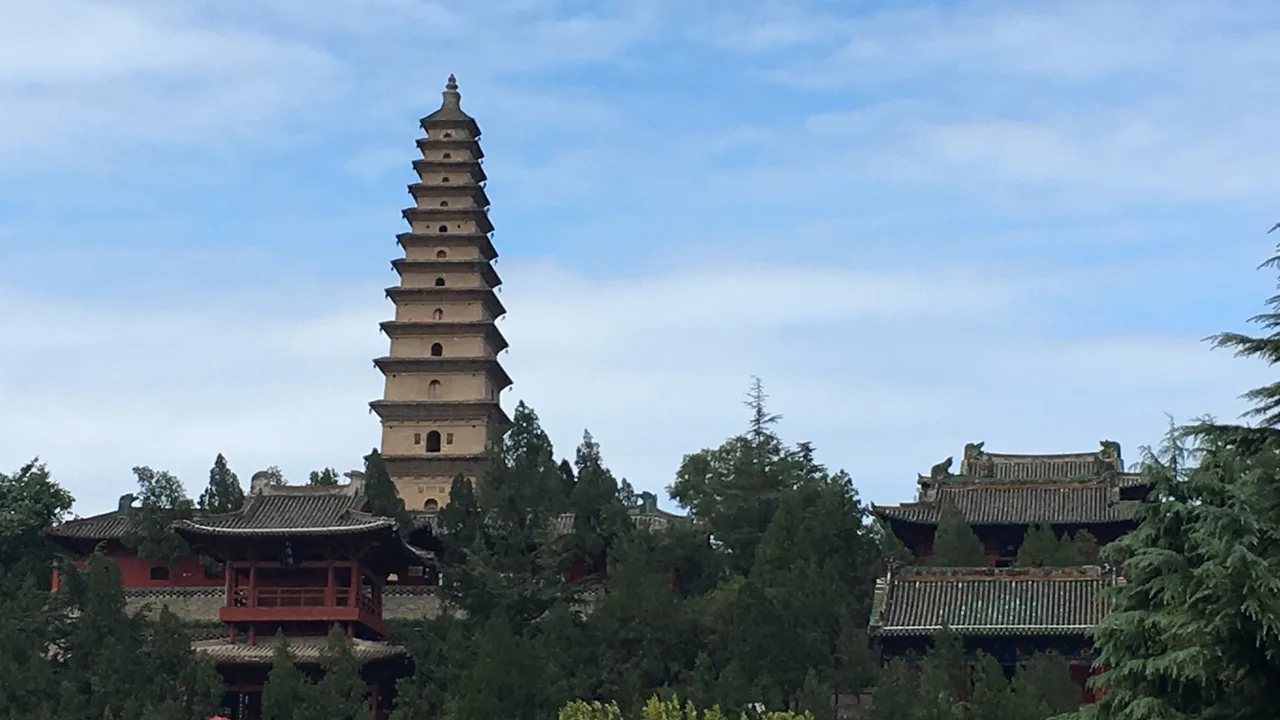
Pujiu Temple (普救寺), on a ridge near Puzhou in Yongji, is where the Romance of the Western Chamber is set, the Yuan love story of Zhang Sheng and Cui Yingying. Most of what you see is a modern rebuilding around an old brick pagoda. Give it about 90 minutes and pair it with Stork Tower nearby. It does not justify a trip on its own.
What is actually old here?
Be clear about this before you pay. The temple burned and was ruined more than once. The halls, garden and "Western Chamber" courtyard you walk through today are reconstructions laid out to match the play. The Yingying Pagoda (莺莺塔), a square brick pagoda rebuilt in the Ming, is the main genuinely old structure. It is famous for an echo: clap or knock stones near its base and you hear a frog-like croak that rings back off the brick.
So come for the story, the setting and the view. The ridge looks south to the Zhongtiao mountains and west toward the Yellow River plain. Do not come expecting a Song-era survivor like Huayan Temple in Datong.
Why does the play matter?
Wang Shifu's Romance of the Western Chamber (西厢记) is one of the best-known works of Chinese drama. Students still read it, and opera troupes still perform it. Its scholar and young noblewoman meet in this temple, exchange poems over a wall and defy the girl's mother. The site plays this up heavily, with couples' wishes, red locks and performances on busy days. If you know the story, it is a gentle afternoon. If you do not, read a short summary on the way so the courtyards mean something.
How do you pair it?
Stork Tower (鹳雀楼). This is the rebuilt tower of Wang Zhihuan's famous Tang quatrain about climbing higher to see farther. It is a modern reconstruction, but it is tall and has a broad view over the Yellow River flats, a short drive away. Same operator, separate ticket.
Puzhou iron oxen (蒲津渡铁牛). Tang-dynasty cast-iron oxen that anchored a pontoon bridge, excavated near the river. Add them if you like engineering history.
Guandi Temple. Xiezhou Guandi Temple is on the way from Yuncheng. Bus 116 links Yuncheng, the temple and Yongji, so an early start covers both.
How do you get there?
The high-speed train from Yuncheng North to Yongji North takes about 20–25 minutes. From there use a taxi or ride-hail to the temple. Coming from Xi'an is easy too, since Yongji is on the same line. The temple's own transport notes describe a two-kilometre run along the tourist road from the Yongji West expressway exit.
Tickets, hours and phone
Checked October 2026 (Asia/Shanghai). Yongji's culture and tourism bureau page (yongji.gov.cn) and the gate win over listings.
Ticket. 60 yuan from 1 April to 31 October and 50 yuan from 1 November to 31 March. Half price for ages 6–18 and students; free for under-6s, children 1.2 m and under, and visitors 60 and over, with ID. Sold at the gate and on Meituan.
Hours. The bureau lists 8:00–18:00 in peak season and 8:30–17:30 off-season. Other listings differ by half an hour, and holiday hours have run later, so plan to enter by mid-afternoon.
Phone. 0359-8485263.
Who should skip it?
Architecture purists with limited time. Spend the day at Yongle Palace or Feiyun Pavilion instead. The three-day plan treats Pujiu as an afternoon, not a destination.
Cover photo: hwcmsb@126 / Wikimedia Commons (CC BY 2.5)
More from Yuncheng
- history / 4 min readXiezhou Guandi Temple, 20 km south-west of central Yuncheng, is the largest and oldest-rooted temple to Guan Yu; give it two to three hours, enter by the Jieyi Garden, and check whether the Chunqiu Tower statue area has reopened.
- history / 4 min readYongle Palace in Ruicheng holds China's grandest surviving Daoist mural cycle, sawn off the walls and moved in the 1950s–60s ahead of the Sanmenxia reservoir; allow two hours, bring patience for dim halls, and check Monday opening before going.
- history / 4 min readFeiyun Pavilion, a timber tower inside Wanrong's Dongyue Temple and a Black Myth: Wukong location, costs about 10 yuan and takes an hour; you can usually climb its steep stairs, and it pairs with Houtu Temple by the Yellow River.