The South Pavilion to Yingxian's North Pagoda: Feiyun Pavilion in Wanrong
Feiyun Pavilion, a timber tower inside Wanrong's Dongyue Temple and a Black Myth: Wukong location, costs about 10 yuan and takes an hour; you can usually climb its steep stairs, and it pairs with Houtu Temple by the Yellow River.
Published
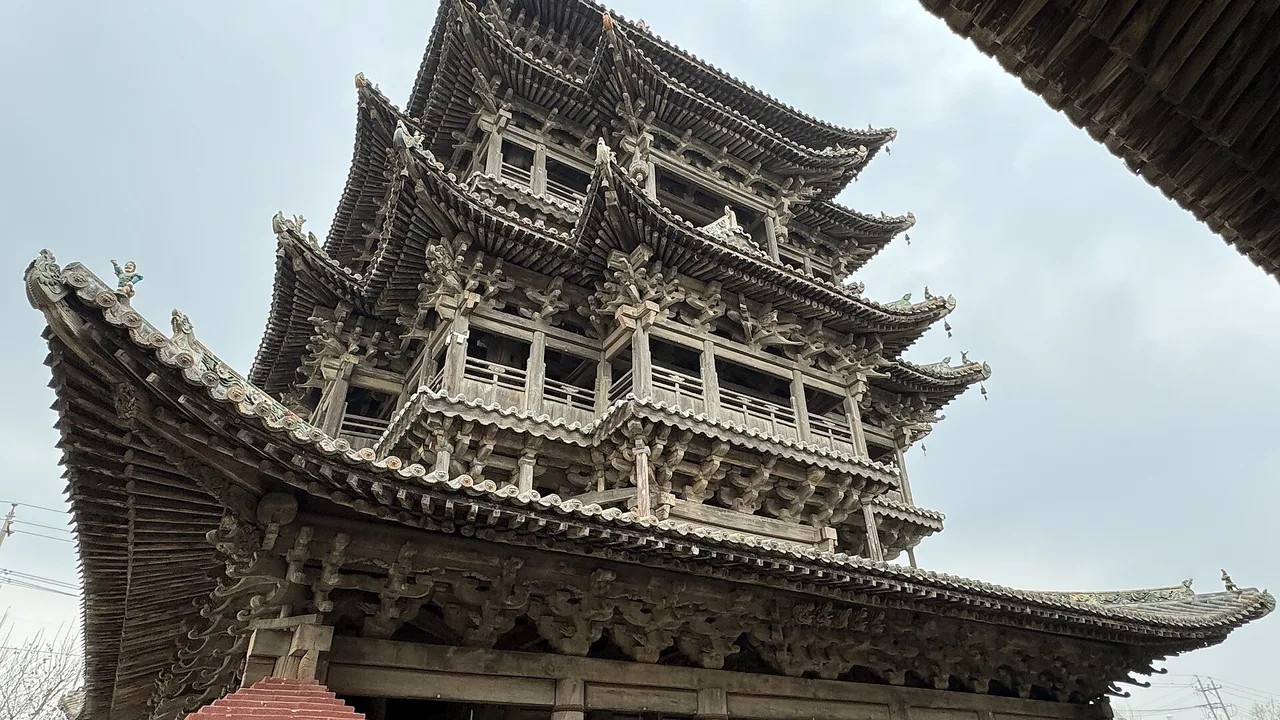
Feiyun Pavilion (飞云楼) is a Ming-era timber tower inside Wanrong's Dongyue Temple. It is often paired with Yingxian's wooden pagoda as "the south pavilion and the north pagoda", and it appears in Black Myth: Wukong. Budget an hour and about 10 yuan, and you can usually climb it. That makes it one of the best-value stops in Yuncheng.
What makes it special?
From outside it looks like three storeys, but there are more floors inside. Four tall pillars run up through the core, and the roofline is a pile of brackets and flaring eaves with dozens of upturned corners, so the whole thing looks like it is about to lift off. The name means "flying cloud". It is built with joinery rather than nails, and almost every visitor post makes that point.
If you have stood under Yingxian Wooden Pagoda, the comparison is useful. Yingxian is a Liao-dynasty monument you can only see from the ground. Feiyun is smaller and later, and you can usually walk up into it. Here you touch the structure. In Yingxian you look at it from below.
What is the Black Myth connection?
Black Myth: Wukong (2024) used scans of real Shanxi buildings. Feiyun Pavilion and Qiufeng Pavilion at Houtu Temple were among the Wanrong sites on Shanxi's official "follow Wukong" route. Expect some gamers photographing the eaves and a few people in Ming-style costume. It is still nowhere near Pingyao-level crowds.
Can you climb it, and what should you watch for?
Recent visitors report climbing to the upper levels by narrow, steep wooden stairs. Wear flat shoes with grip, keep hands free, and take children slowly. Smoking and open flames are forbidden in the timber building, and flash photography is restricted in parts of it. Access to upper floors can change for conservation, so treat the climb as likely, not guaranteed.
Once inside, look up the central pillars at the bracket work and caisson. Then walk back across the courtyard to see the whole silhouette. The low light of late afternoon suits the warm brown wood.
How do you get there?
The temple is at No. 8 West Street (西大街8号) in Jiedian (解店), the Wanrong county seat, roughly an hour's drive north of Yuncheng. Wanrong has a station on the rail line from Yuncheng, and from there a short taxi reaches the temple. Long-distance buses from Yuncheng also run to the county town. For most visitors the efficient plan is a hired car for a Wanrong day: Feiyun in the morning, then on to Houtu Temple on the Yellow River, about 40 km south-west. Add the Balong Temple Pagoda if you have time.
Tickets, hours and phone
Checked October 2026 (Asia/Shanghai). The temple gate and Wanrong county's tourism notices win over this page. No stable official web page was found. The details below come from current listings and recent visitor reports.
Ticket. About 10 yuan. Visitors 60 and over, children under 1.2 m and service members with ID are listed as free, and students pay half. ID card or QR entry is reported at the gate.
Hours. Listed as 8:00–18:00 from April to October (last entry 17:40) and about 8:00–17:30 from November to March (last entry 17:10). One recent post gives an 8:30 winter opening, so do not arrive right at opening time.
Phone. Listed as 0359-4527977.
Who should go?
Anyone who likes old buildings, and anyone who played the game. It takes an hour and costs little, and the building is spectacular. The only reason to skip it is if you have no car and only one day. In that case choose the Guandi Temple, which is on a direct bus.
Cover photo: Patrick20242023 / Wikimedia Commons (CC BY-SA 4.0)
More from Yuncheng
- history / 4 min readXiezhou Guandi Temple, 20 km south-west of central Yuncheng, is the largest and oldest-rooted temple to Guan Yu; give it two to three hours, enter by the Jieyi Garden, and check whether the Chunqiu Tower statue area has reopened.
- history / 4 min readYongle Palace in Ruicheng holds China's grandest surviving Daoist mural cycle, sawn off the walls and moved in the 1950s–60s ahead of the Sanmenxia reservoir; allow two hours, bring patience for dim halls, and check Monday opening before going.
- history / 4 min readHoutu Temple at Miaoqian village, about 40 km from Wanrong town, is where Han and Song emperors sacrificed to the Earth; Qiufeng Pavilion inside is a Black Myth: Wukong location. Ticket about 20 yuan; don't count on climbing the pavilion.