Emperors' Altar on the Yellow River: Houtu Temple and Qiufeng Pavilion at Wanrong
Houtu Temple at Miaoqian village, about 40 km from Wanrong town, is where Han and Song emperors sacrificed to the Earth; Qiufeng Pavilion inside is a Black Myth: Wukong location. Ticket about 20 yuan; don't count on climbing the pavilion.
Published
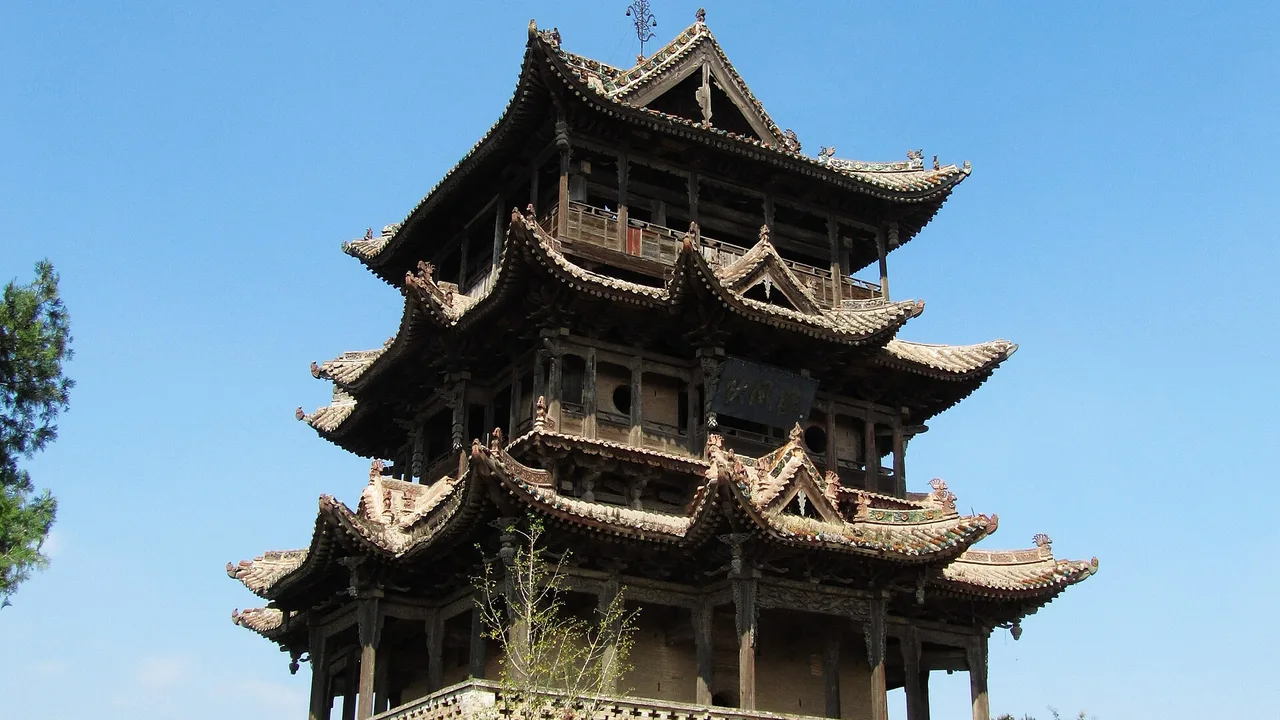
Houtu Temple (后土祠) stands on the Yellow River bank at Miaoqian village, about 40 km south-west of Wanrong town. Han and Song emperors came here to sacrifice to the Earth Mother. Its Qiufeng Pavilion (秋风楼) is a Black Myth: Wukong location. It is worth the drive for the setting and the stage, but do not count on climbing the pavilion.
Which Houtu Temple is this?
Shanxi has several. Lingshi, in Jinzhong, has a Houtu Temple (后土庙) famous for its caisson ceiling, which appeared in the Black Myth: Zhong Kui demo. This one at Wanrong is the old imperial altar site at Fenyin (汾阴), near where the Fen River meets the Yellow River. When people say "Wukong's Qiufeng Pavilion", they mean Wanrong.
Why did emperors come here?
According to the temple's history, Emperor Wu of Han made repeated journeys to Hedong and sacrificed here. His poem Autumn Wind (秋风辞) is the source of the pavilion's name. Song Zhenzong came in the early eleventh century, and a stele gallery from that visit survives. The river moved, floods destroyed earlier buildings, and the present compound was rebuilt on higher ground. It is a long walled complex with a gate, a rare "pin" (品)-shaped group of three stages, a main hall to the Earth Mother, and the pavilion at the back.
What is Qiufeng Pavilion like?
It is a tall brick-and-timber tower on a high platform, with a passage cut east to west through its base. The gate inscriptions face toward Lu and Qin, the old states east and west. Steles carrying Emperor Wu's poem are kept on the upper floors. The current building dates from a Qing rebuilding, which a local photographer's account places in 1870.
Access. At least one recent visitor review says the upper floors could not be climbed. Assume you will see the pavilion from the ground and the courtyards, and treat going up as a bonus if the gate allows it. The view you came for, the pavilion against the wide river plain, works from outside.
How does it fit into a day?
This is car country. From Yuncheng it is roughly 1.5 hours or more. Pair it with Feiyun Pavilion in Wanrong town and, if you want something even quieter, the lone Balong Temple Pagoda, which is also in Ronghe town. A weekend "城景通" shuttle to Wanrong and Hejin has run in past seasons. Its schedule changes, so check the mini-program before you plan around it. Spring and early autumn give the clearest river views. Summer haze flattens them.
Tickets, hours and phone
Checked October 2026 (Asia/Shanghai). The gate and Wanrong county tourism notices win. No stable official web page was found, and the details below are from current listings.
Ticket. About 20 yuan for adults. Over-60s, children under 1.2 m or 6 and under, and some other groups are listed as free with ID.
Hours. Listed as 8:30–18:00 all year, with last entry 17:30. One listing says 17:00, so arrive by mid-afternoon.
Phone. A complaints line is listed as 0359-4589580.
Who should skip it?
If you have no car, or you are not interested in ritual history or river landscapes, Feiyun alone gives you most of the Wanrong architecture in an hour. Anyone on the Wukong trail, or anyone who wants to stand where Han emperors stood above the Yellow River, should come. The three-day plan puts Wanrong on its own day.
Cover photo: 猫猫的日记本 / Wikimedia Commons (CC BY-SA 3.0)
More from Yuncheng
- history / 4 min readXiezhou Guandi Temple, 20 km south-west of central Yuncheng, is the largest and oldest-rooted temple to Guan Yu; give it two to three hours, enter by the Jieyi Garden, and check whether the Chunqiu Tower statue area has reopened.
- history / 4 min readYongle Palace in Ruicheng holds China's grandest surviving Daoist mural cycle, sawn off the walls and moved in the 1950s–60s ahead of the Sanmenxia reservoir; allow two hours, bring patience for dim halls, and check Monday opening before going.
- history / 4 min readFeiyun Pavilion, a timber tower inside Wanrong's Dongyue Temple and a Black Myth: Wukong location, costs about 10 yuan and takes an hour; you can usually climb its steep stairs, and it pairs with Houtu Temple by the Yellow River.