Twenty-Eight Star Gods in a Side Hall: Visiting Jincheng's Yuhuang Temple
Jincheng's Yuhuang Temple is a Song-founded Daoist complex whose Yuan clay figures of the 28 Lunar Mansions, seen in Black Myth: Wukong, stand in a side hall of the rear court; book online, go on a weekday, allow an hour or two.
Published
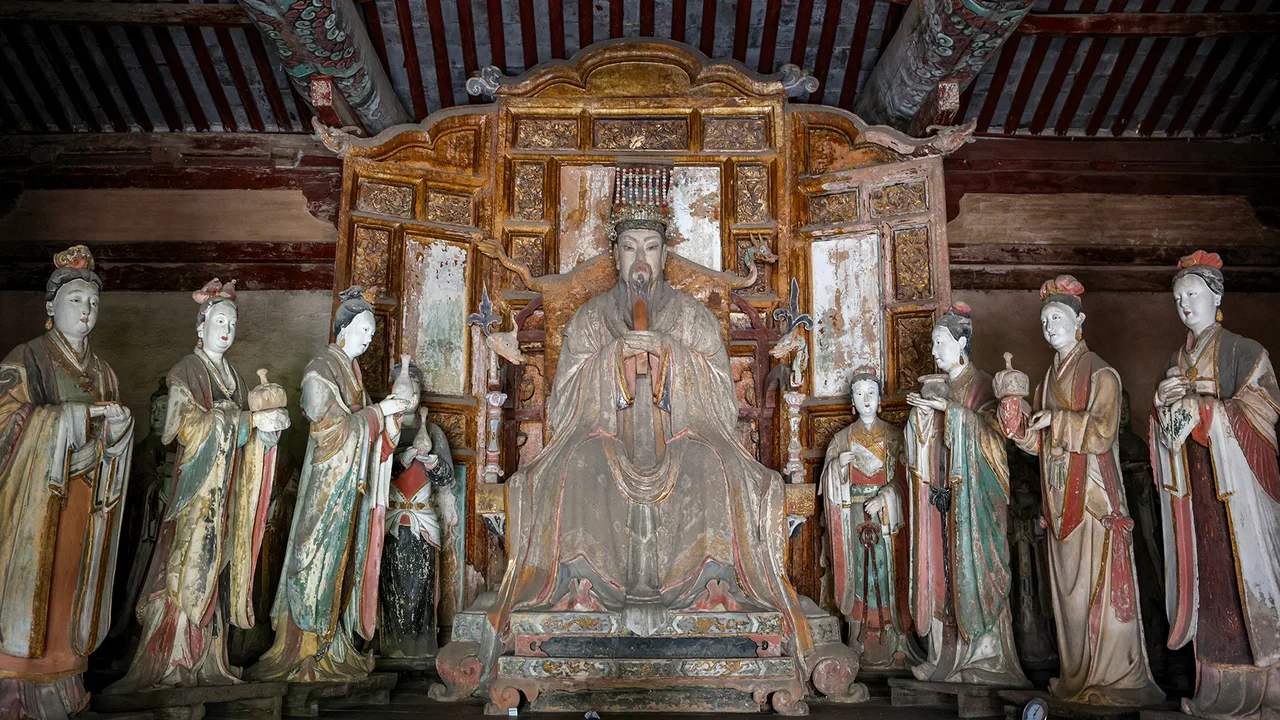
The 28 Lunar Mansions (二十八星宿) at Jincheng's Yuhuang Temple (玉皇庙) are Yuan-era clay figures of the star gods, each paired with an animal, standing in a side hall of the rear court. The temple is run as a museum: book online, check for one-off closures, and allow one to two hours.
What is Yuhuang Temple?
It is a Daoist temple to the Jade Emperor in Fucheng village, on the eastern edge of Jincheng. Founded in 1076 under the Northern Song, it was rebuilt after war damage, and its present layout dates from a Yuan rebuilding in the fourteenth century. Four courtyards climb a gentle slope over six terraces, with dozens of small halls to gods of the sky, harvest, medicine, plague and the stars. It is now managed by the city's heritage centre as the Yuhuang Temple Painted Sculpture and Mural Museum.
Where are the 28 Lunar Mansions, and why do people come for them?
Walk straight up the axis to the rear court, the highest one, and look to the side hall where the Lunar Mansions stand. The 28 Mansions are the Chinese division of the sky into lunar lodgings. Here each one is a person, a scholar, a warrior or an old man, alongside or astride an animal. Faces and gestures are unusually lively for temple figures, and they are often cited as among the finest Yuan clay sculpture in China. Tradition attributes them to a Yuan court sculptor, Liu Yuan, though the attribution is debated.
The game Black Myth: Wukong recreated them, which is why the temple suddenly became busy in 2024. The real hall is narrow, and the figures sit behind barriers. Visitors are not there to pose with them. Look at the hands, the drapery and the animals' expressions.
What else should you see?
The other halls of the rear court hold more star and weather gods. The ten-odd small halls around the middle court are worth a slow loop, many with old figures or fragments of murals. If you have seen the Liao figures at Huayan Temple in Datong, this is a different world: smaller, Daoist, folk in feel, and much more crowded with deities.
How do you get there?
The temple sits on the city's east side, a taxi or ride-hailing car from the centre or from Jincheng East high-speed station. During Golden Week 2026, holiday station coaches to Dayang and Jueshan called at Yuhuang Temple. That service is seasonal. On ordinary days, budget a taxi. For the rest of Jincheng's transport see getting around Jincheng.
Hours, booking and closures — what should you check?
Checked October 2026 (Asia/Shanghai). The Jincheng Museum's official site (jcbwg.cn) and WeChat account “晋城博物馆” win over this page.
Hours. Open Monday to Sunday, 9:00–17:00, with ticket checks stopping at 16:00.
Booking. Visits are by online reservation through the “晋城博物馆” WeChat account, according to the museum's notices. Bring the passport you booked with. We could not find a ticket price on the official pages. Several reports describe entry as free with booking, but confirm when you reserve.
Closures. The museum posts one-off closures at short notice, including several in April and September 2026 for events and maintenance. Check the notices page the day before.
Phone. 18335684040 (9:00–17:00).
Is it worth a special trip?
If you care about sculpture, yes: it is one of the best reasons to stop in Jincheng. Pair it with Qinglian Temple, also run by the museum, for a half-day of Tang and Yuan figures. The two-day plan puts them together.
Cover photo: Windmemories / Wikimedia Commons (CC BY-SA 4.0)
More from Jincheng
- history / 4 min readHuangcheng Xiangfu is the walled family compound of Qing chief minister Chen Tingjing in Yangcheng; choose the 120-yuan ticket for the mansion alone or 150 yuan to add Guoyu and Haihui over three days, and allow half a day.
- culture / 4 min readGuoyu, next to Huangcheng Xiangfu, is a walled Ming–Qing village where people still live, with the tall Yulou refuge tower; Haihui Temple's twin pagodas are a short ride away. Both come with the 150-yuan ticket.
- history / 4 min readQinglian Temple, 17 km south-east of Jincheng, is one of China's earliest Pure Land temples and keeps rare Tang painted figures; in 2026 the upper temple is closed for repairs while the lower temple is open by online booking.