Pace the Cliff, Not the Numbers: How to Spend a Day at Yungang Worth It
At Datong’s Yungang Grottoes, a day is worth it when you pace one corridor — Tan Yao Five Caves for scale, later chambers for detail — not a cave-number race.
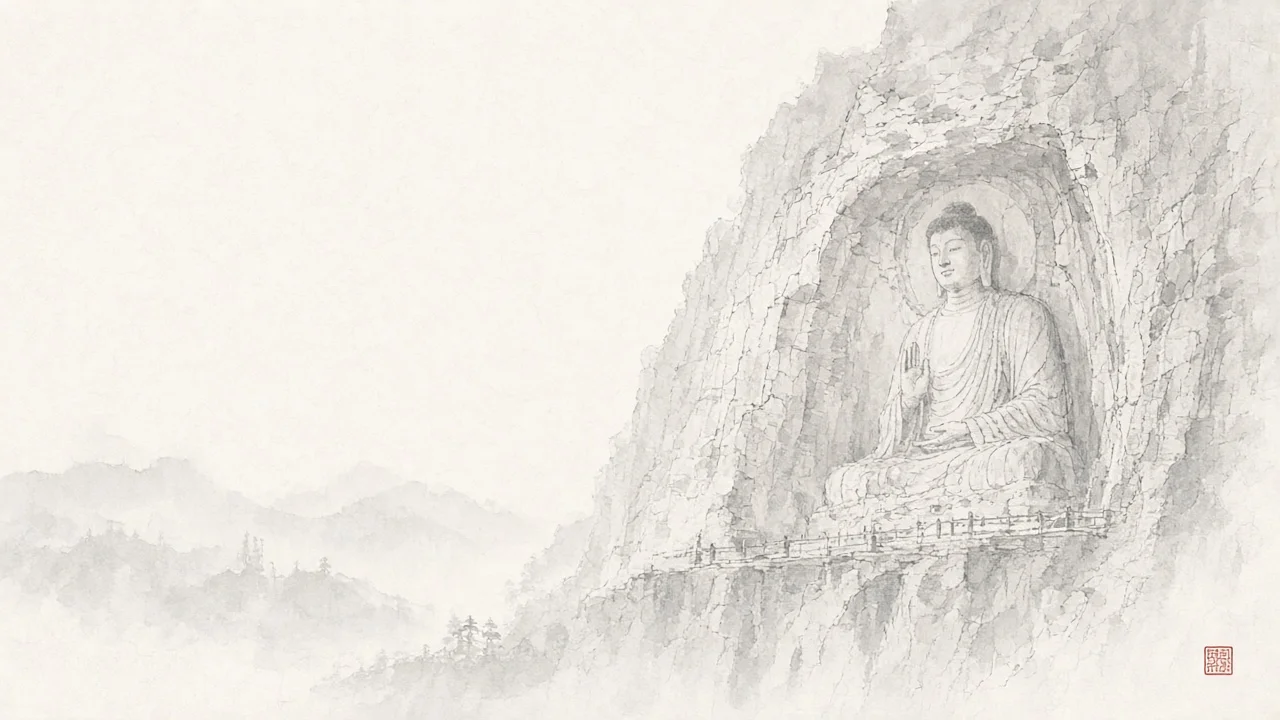
At Datong’s Yungang Grottoes (云冈石窟), a day is worth it when you pace one corridor direction — monumental Tan Yao Five Caves for imperial scale, then later chambers for painted detail — rather than racing cave numbers. Arrive early, book real-name tickets ahead, and treat the cliff as sequence, not a photo checklist.
What pacing makes a day worth it — not a cave-number race?
The cliff reads west of Datong as a linear corridor of rock-cut niches, not a museum of stamped doors. UNESCO inscribed the complex in 2001 for the mid-5th to early-6th-century achievement under Northern Wei imperial patronage when Datong (then Pingcheng) was the capital (whc.unesco.org/en/list/1039, checked October 2026). What changes the day is direction and dwell time: pick one slow pass along the face, linger where scale or paint actually stops you, and skip the urge to collect every numbered cave.
Half a rushed circuit plus a taxi to the next “must-see” usually wastes both. Soft city frame for how caves sit beside timber temples, wall, and Hanging Temple fringe: the Datong cultural landscape overview.
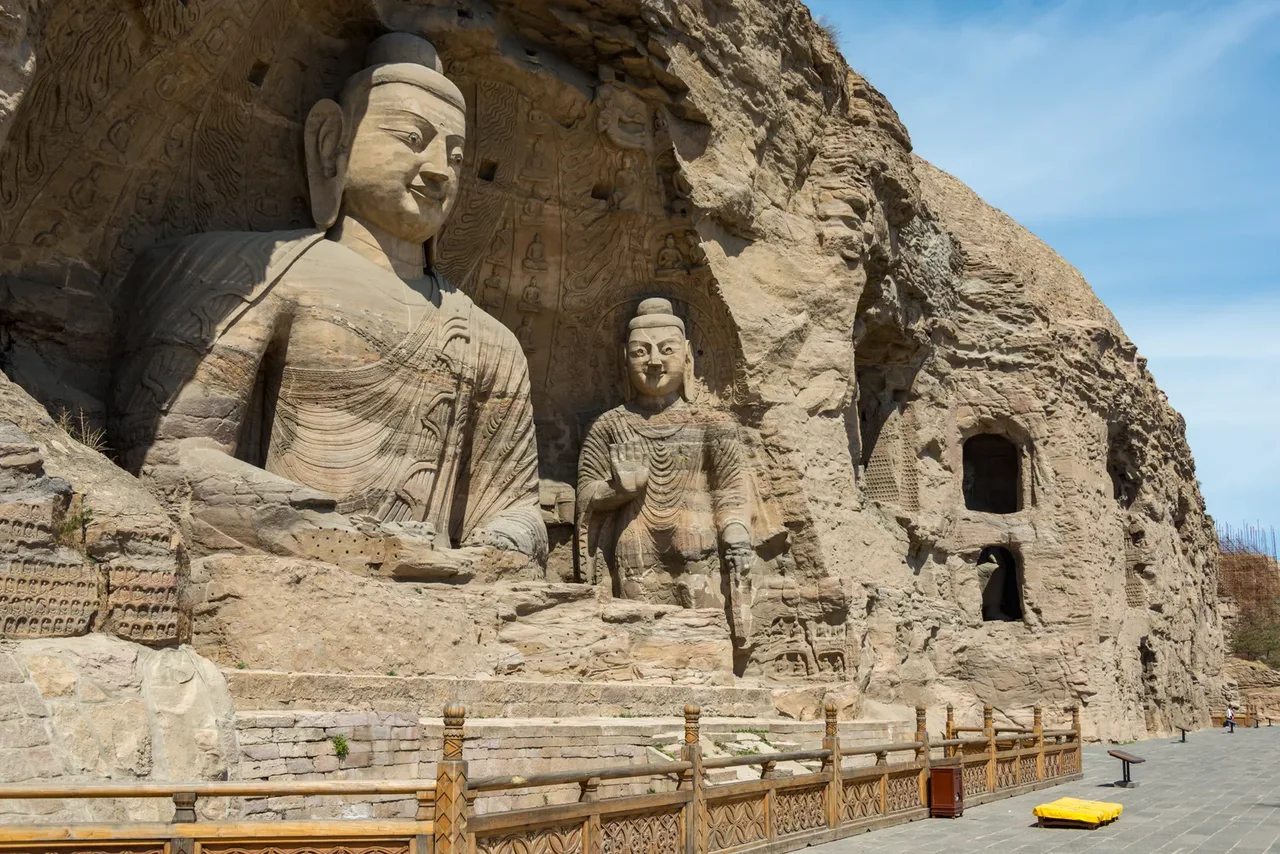
Photo: xiquinhosilva / Wikimedia Commons (CC BY 2.0)
What do the Tan Yao Five Caves give you — and what do later chambers give?
The Tan Yao Five Caves (昙曜五窟, roughly caves 16–20) are the imperial-scale cluster UNESCO singles out for strict layout unity — colossal seated Buddhas, open façades, and a political claim carved into living rock. From the path they read as mass and presence; inside (where open) you get the awkward pleasure of sharing a chamber with everyone who came for the same silhouette. That is the trade: early stop = scale judgment; later stop = detail.
Later chambers along the corridor shift the register — painted surfaces, denser relief, and smaller niches that repay foot pace more than a mid-lane photo sprint. Treat both stretches as one sequence on one day, not as two attractions to “finish.” Racing cave numbers for a complete set usually costs the light and patience that make either stretch worth standing still for.
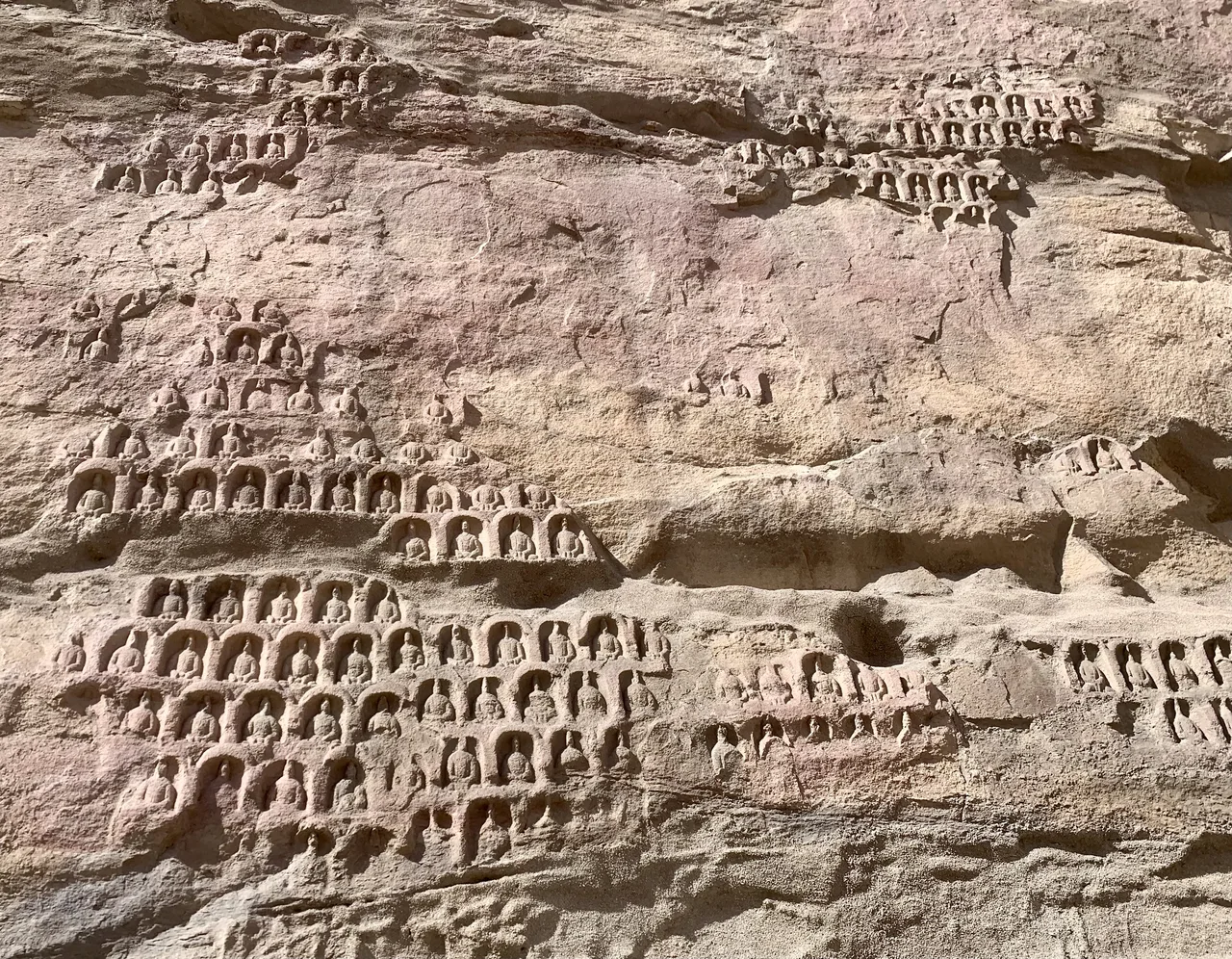
Photo: Dudva / Wikimedia Commons (CC0)
What else is worth time — and what is checklist noise?
Worth time: arriving near open so the corridor is still cool and quieter; one full direction before you double back; shade and water between the monumental stretch and the painted chambers; a short pause at a single open façade you actually remember. Protection work sometimes closes individual caves — Mid-Autumn 2026 notices, for example, temporarily shut caves 5, 16, and 18 while other main caves stayed open — so build flexibility into the pace rather than a fixed number list.
Checklist noise is zigzagging for identical Buddha shots, stacking Yungang and the Hanging Temple into one exhausted daylight window, or treating the site as a game map. If Black Myth: Wukong brought you here, keep it as recognition only — the Stories piece Black Myth to Shanxi’s ancient architecture maps verifiable sites; this page stays a day-worth judgment, not a walkthrough.
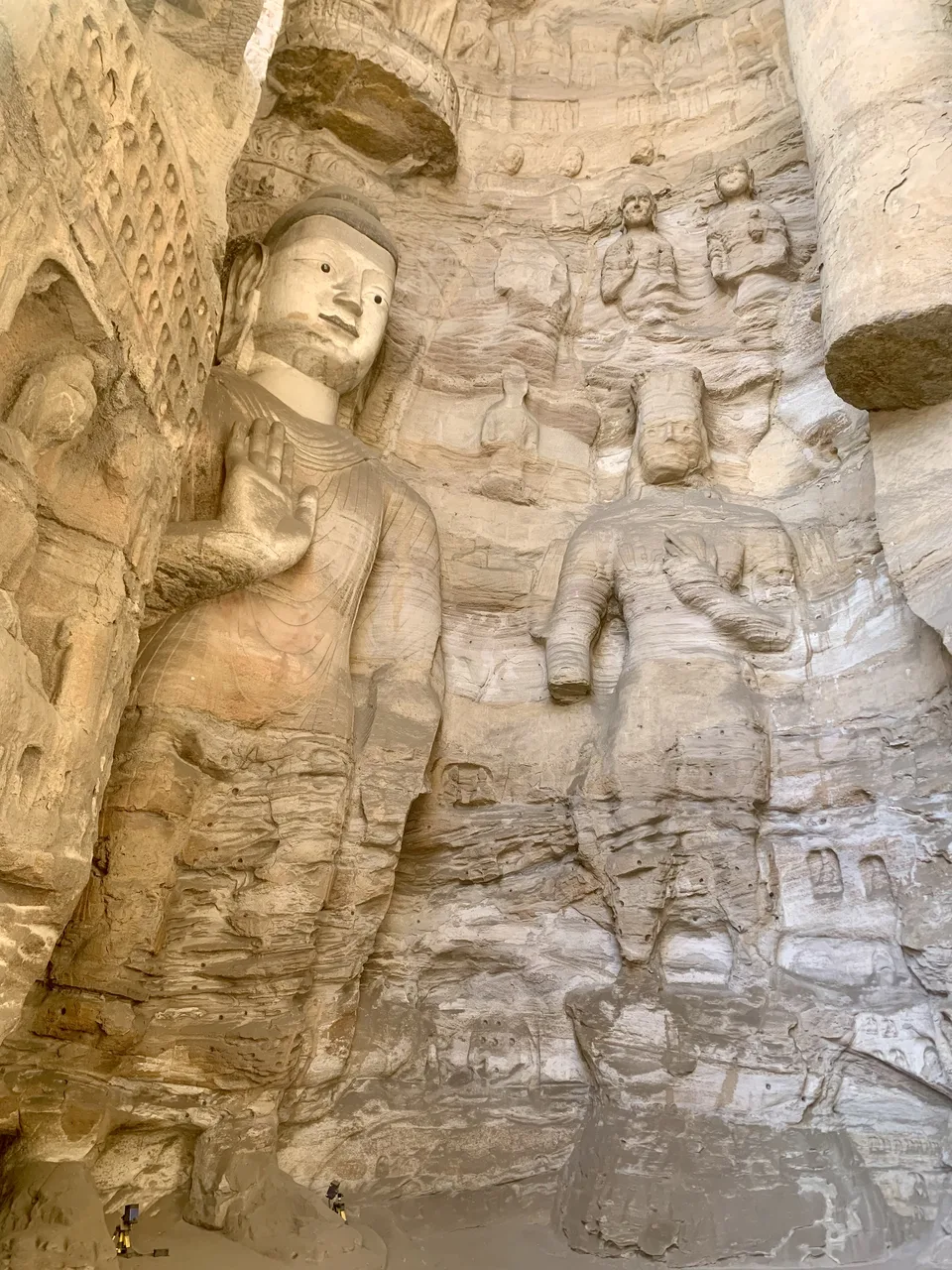
Photo: Dudva / Wikimedia Commons (CC0)
When should you go, and how long?
Spring and autumn suit a first full day: April–June and September–October for clearer air and kinder walking heat. Midsummer works if you enter at open and accept a slower midday stretch; winter days are short and the post–8 October autumn window already closes early. Plan most of a daylight window — roughly four to six hours with photo stops and a meal buffer — rather than a ninety-minute dash that only proves you found the cliff.
Night or special programs, when offered, are separate products from daytime admission. If you only have one window, spend it on the corridor sequence, not on stacking day and night into one exhausted visit.
Hours, tickets, and how to get there?
Checked October 2026 (Asia/Shanghai). Yungang Academy WeChat / mini-programs and municipal notices win — re-confirm the morning you travel; prefer “云冈石窟官微,” “云冈石窟文旅,” or the “云冈研究院” / “云冈石窟文旅” mini-programs over third-party clocks.
Hours. About 08:30–16:30, stop entry after 16:30 after the 2026-10-08 autumn shift (山西发布 via 新黄河; Academy notice echoed across provincial coverage, checked October 2026). Earlier September windows ran longer; seasonal shifts are normal — trust the morning check.
Tickets. Peak season (1 Apr–31 Oct) commonly about ¥120 adult / ¥60 child–student; book real-name 1–15 days ahead via the Academy / scenic mini-programs (dt.gov.cn reservation notice, checked October 2026). Off-peak and concession rules change with annual notices — confirm the month you travel before you pay. Heritage brief: UNESCO. Last checked: October 2026.
Transit. High-speed arrivals usually land at Datong South (大同南站); Datong Station (大同站) sits closer to the old city. A municipal scenic through-bus has linked Datong South to Yungang in about 40 minutes at ¥10 when operating (dt.gov.cn, checked October 2026). Taxi or ride-hail from either station works when the through-bus is not running — confirm bus numbers and last return the morning you go.
Who is this for — and who should skip?
Come if you want a day-worth decision: one corridor sequence, Tan Yao scale then later detail, with tickets and hours you can verify — not a cave encyclopedia. Skip if you only need a single Buddha photo from a tour-bus window, or if you planned to bolt Yungang and the Hanging Temple into the same short afternoon. Start early, walk one direction, and let a few chambers earn their place by how they change your pace, not by how many numbers you can recite aloud.
More from Datong
- culture / 7 min readDatong reads clearest as Northern Wei caves, Liao-Jin timber temples, the old city wall, and the Hanging Temple fringe — a citywide frame before any day plan or single-site deep dive.
- history / 7 min readFrom a Datong base, Hanging Temple near Hunyuan is worth a day trip when you book capped climbing tickets and treat it as one gorge stop — not a walk from the old city.
- culture / 7 min readAt Datong’s Huayan and Shanhua temples, choose by what you want to read — Liao sculpture and dual-axis halls, or a complete axial courtyard — not two generic old-temple twins.