The 15-minute gameplay demo of Black Myth: Zhong Kui, released on August 20, 2026, puts at least two real Shanxi buildings on screen — and both are places you can stand in front of on an ordinary trip through the province.
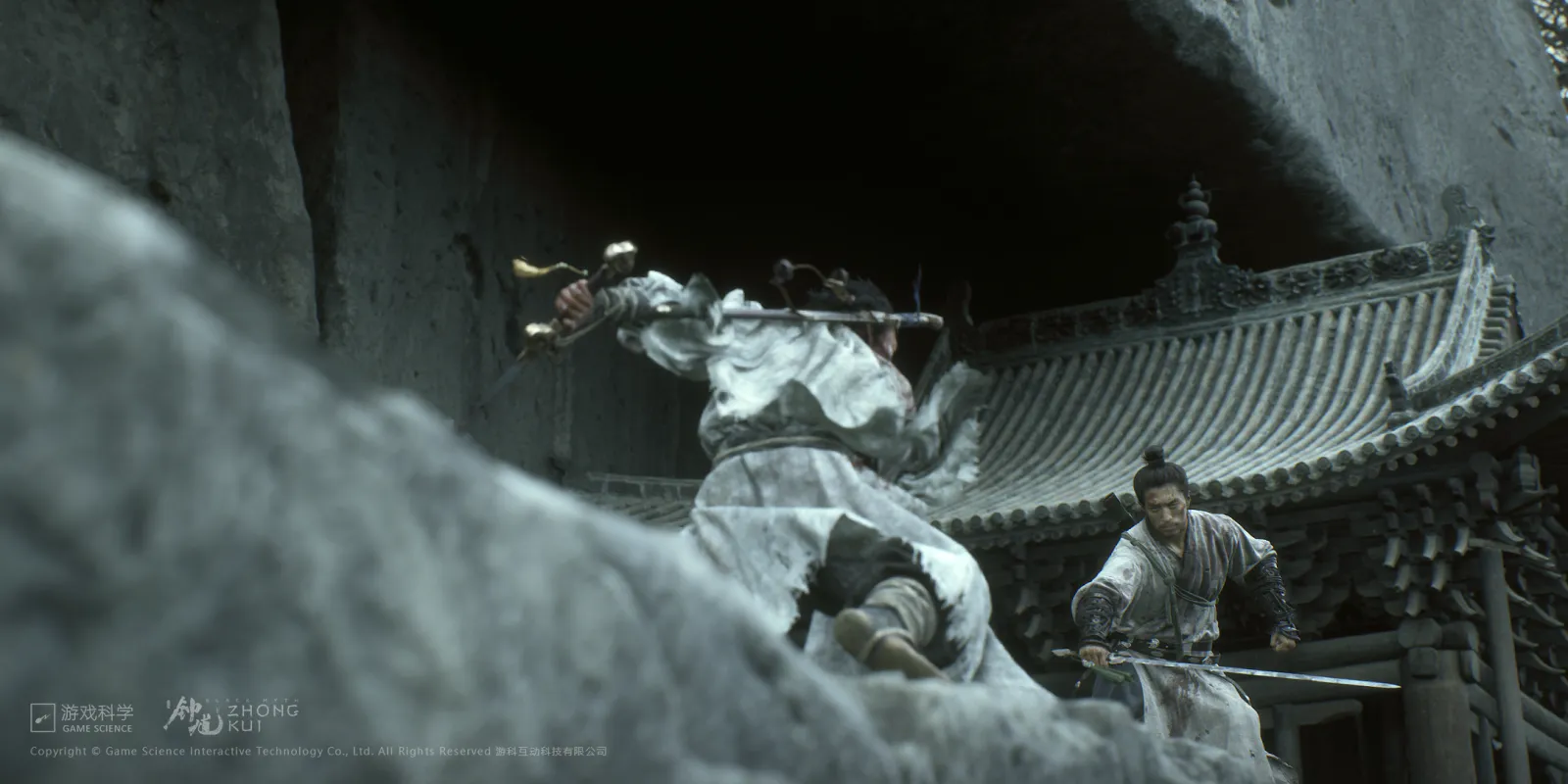
Image: Black Myth: Zhong Kui (Game Science).
Who is Zhong Kui
Zhong Kui (钟馗) is one of the oldest and most recognizable figures in Chinese folk religion: the demon-queller. The core legend is short. A gifted scholar travels to the capital to sit the imperial examination and does well, but he is judged too ugly for the honor he has earned. In most tellings he takes his own life on the palace steps out of shame and anger. After death, he becomes a ghost king whose job is to hunt down and devour the small demons that bring sickness and bad luck to ordinary households.
The story became widely known through a later court legend. An emperor of the Tang dynasty falls ill and, in a fever dream, sees a huge, bearded figure in a scholar's hat seize and swallow a demon that had been tormenting him. The figure introduces himself as Zhong Kui. The emperor wakes up cured and has a painter record the image. From then on, Zhong Kui's picture travelled far beyond the palace.
That image is still what you will meet in China today: a big, scowling man with a full beard, a black official's hat and a red or green robe, often holding a sword, sometimes with a bat flying overhead (in Chinese the word for bat sounds like the word for good fortune). Families pasted his portrait on doors at the New Year and around the Dragon Boat Festival in early summer, when disease was thought to spread. He turns up in woodblock prints, paper-cut decorations, opera masks and temple murals, and in ink paintings by famous artists.
For a traveler, the useful point is this: Zhong Kui is not a mythic hero from one novel, the way Sun Wukong comes from Journey to the West. He is a household guardian, rooted in everyday worship and seasonal custom. That fits a game set in northern Chinese temples, where local gods, earth deities and guardian figures shared the same courtyards for centuries.
Two real sites from the demo
Chinese media reported on both places within weeks of the demo. Details below come from local officials quoted in Shanxi Evening News and from Cover News. Checked October 2026. Official information wins: access, renovation work and caretaker arrangements at small heritage sites change without much notice, so confirm with the local culture and tourism bureau or the site itself before you travel.
Lingshi Houtu Temple (灵石后土庙), Jingsheng, Jinzhong. The temple stands in Jingsheng (静升), a village and town in Lingshi county, in Jinzhong prefecture of central Shanxi. It has been a national key cultural relics protection site since 2006. The building fans recognized from the demo is the offering hall in front of the main hall: a square, open pavilion with a single-eave hip-and-gable roof, still carrying Yuan-dynasty glazed tiles. The main hall behind it keeps an ink inscription dated 1304, also in the Yuan dynasty, which makes this one of the better-dated small temples in the region.
- Access: the temple is not fully open to the public. According to the Lingshi county culture and tourism bureau, speaking to Shanxi Evening News on August 26, 2026, visitors should call the caretaker on the phone number posted at the gate and arrange the visit in advance. Do not assume you can walk in.
- What to expect: a quiet village temple, not a ticketed scenic area. Be respectful of the caretaker's time and of any restrictions on photography or entering halls.
- Checked October 2026. Official information wins — confirm with the Lingshi culture and tourism bureau before going.
Balong Temple Pagoda (八龙寺塔), Wanrong, Yuncheng. This lone brick pagoda stands at Zhongli village (中里村) in Ronghe town, Wanrong county, part of Yuncheng in Shanxi's far southwest. It was built in 1012, during the Northern Song dynasty. It is a solid, square, seven-storey brick tower about 23.9 meters tall, and it became a national key cultural relics protection site in 2013. The temple it once belonged to is gone; the pagoda now stands alone.
- Getting there: the pagoda is more than 30 km from the Wanrong county seat, a drive of 30 minutes or more. Public transport is not a realistic plan; hire a car and driver.
- Tickets: there is no ticket. There is also no visitor complex around it.
- Current state: the pagoda has been under renovation since 2025, so expect scaffolding or fencing. The pagoda is solid and cannot be climbed.
- Checked October 2026. Official information wins — check with the Wanrong county culture and tourism authorities before making the trip.
Other spots fans matched
Players have also compared frames from the demo with several other places in China. These are fan frame-matching only and have not been officially confirmed as references. They include the Xiantai memorial archway (仙台坊) in Huatan village, Yongjia county, near Wenzhou in Zhejiang, a mixed wood-and-stone archway from 1505; the Yangshan Quarry steles (阳山碑材) outside Nanjing, where enormous stone blocks for a Ming Yongle-era stele were cut but never finished; and the eroded granite landforms of the Qingshan geopark near Chifeng in Inner Mongolia. Each is worth visiting on its own terms, but do not plan a trip around them as "game locations."
How to fit this into a trip
Lingshi with Pingyao. Jingsheng is the same town that holds the Wang Family Courtyard (王家大院), one of Shanxi's large merchant family compounds. That makes the Houtu Temple an easy addition to a day trip from Pingyao, the walled Ming–Qing town that most travelers already use as their base in central Shanxi. A common plan is to hire a car from Pingyao for the day, spend most of it at the Wang Family Courtyard, and add the temple only if you have arranged access with the caretaker by phone in advance. If you cannot reach the caretaker, the courtyard alone still justifies the day.
Wanrong with Yuncheng. The Balong pagoda is in the opposite corner of the province, so it does not combine well with Pingyao on the same day. It makes more sense as part of a stay in Yuncheng, in southern Shanxi. Wanrong county lies to the city's northwest, near the Yellow River. Because the pagoda is a single structure under renovation, decide whether a long drive to see one Song tower from the outside is worth it for you; for people who care about early brick architecture, it can be.
A realistic expectation. Neither site is a game attraction. There are no themed exhibits, and the game's dramatic lighting and cliffs are artistic license. What you get is the real building: its proportions, roof, brick and tile, in a rural setting with few visitors. That is the honest payoff.
Before you go
A few practical points apply to both sites, because neither is run like a ticketed scenic area.
- Phone ahead and keep your plan flexible. Village caretakers have other jobs and may not answer on the first try. If you do not speak Chinese, ask your hotel in Pingyao or Yuncheng, or your driver, to make the call for you and to confirm the day and rough time.
- Use a driver who knows the county roads. Both sites sit outside county seats. Agree on the full route, the waiting time and the return before you set off, and save the Chinese names (灵石后土庙, 静升; 万荣八龙寺塔, 荣河镇中里村) on your phone to show locals.
- Bring what you need. Expect few or no shops, toilets or signs in English at the buildings themselves. Carry water, cash and a charged phone.
- Respect the protection status. Both are national key protected sites. Do not climb on platforms, touch painted or glazed surfaces, or fly a drone without permission.
- Recheck just before travel. Renovation at Balong and access rules at the Houtu Temple can change. Official notices from the county culture and tourism bureaus win over anything written here, including this page.
Related reading
If you came here from Black Myth: Wukong, the earlier Stories page, Black Myth: Wukong to Shanxi's ancient architecture, covers the Hanging Temple, Yungang, the Yingxian Wooden Pagoda and Xiaoxitian. If you are heading to northern Shanxi as well, the Huayan vs Shanhua temples piece explains Datong's surviving Liao–Jin timber halls, which are a useful comparison with the Yuan and Song buildings above.