Gate Tower Above, Waterfall Below: How to See Niangzi Pass in Half a Day
Niangzi Pass on the Shanxi–Hebei border combines a Ming gate fort with a spring-fed waterfall and riverside village on one four-site ticket; allow three to four hours, climb to the gate first and finish by the water.
Published
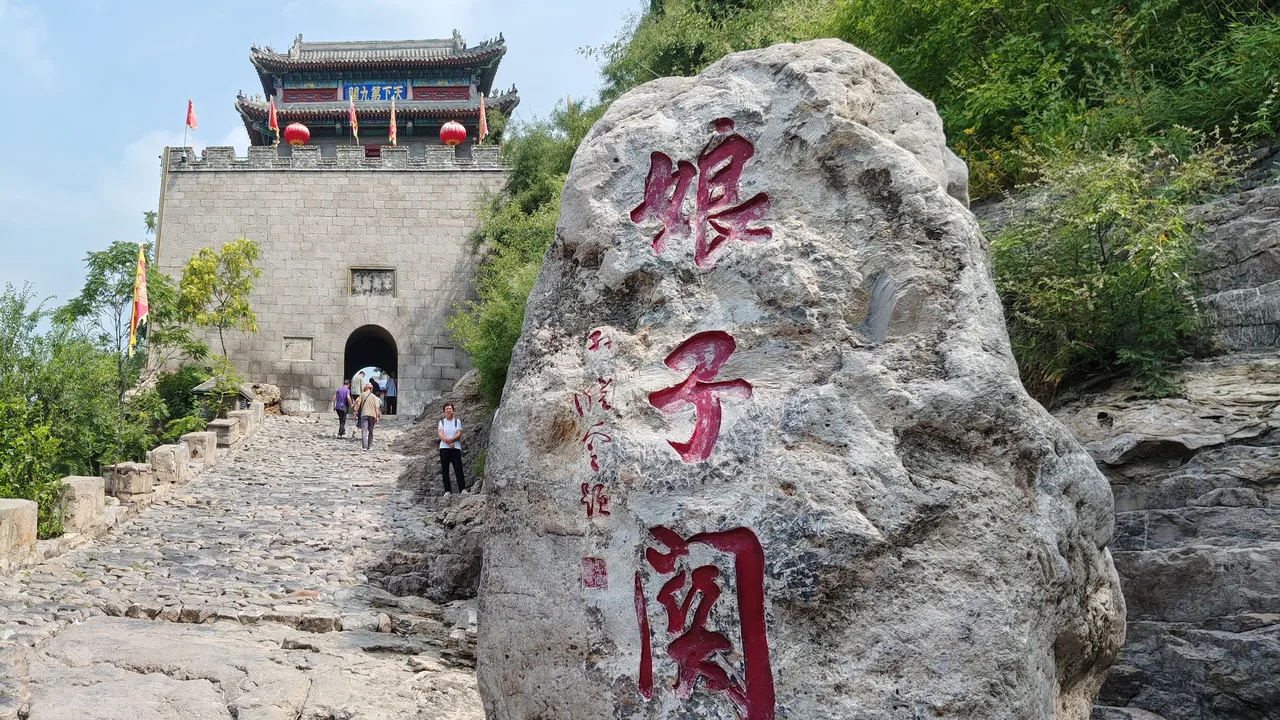
Niangzi Pass (娘子关) in Pingding County, on the Shanxi–Hebei border, puts a Ming gate fort on a cliff above a spring-fed waterfall and a riverside village. One four-site ticket covers the gate, the waterfall, Pingyang Lake and the water village. Allow three to four hours. Climb to the gate first and finish by the water.
Why is it called the "Ninth Pass under Heaven"?
The pass guards a gap where the Mian River (绵河) cuts east through the Taihang Mountains toward the Hebei plain. Any army moving between Taiyuan and the plain had to come through here or through Guguan a little to the south. Chinese sources call it the "Ninth Pass under Heaven" (天下第九关) and sometimes treat it as a link in the inner Great Wall system. The name, "Lady's Pass", comes from Princess Pingyang (平阳公主) of the early Tang, who is said to have held it with an army she raised herself. That story is legend layered on real strategic history. In 1937 the pass saw heavy fighting as Japanese forces pushed toward Taiyuan.
What you see today is a Ming–Qing gate complex. The east gate has its tower, the south gate an inscription, and a short run of wall and lanes inside, much of it restored.
What does the visit actually look like?
The gate fort (关城). Walk up through the village to the south and east gates. The tower terrace looks down the gorge toward Hebei, and it is the one view that explains the place.
The waterfall (瀑布). Springs in the valley floor feed a broad waterfall below the fort, which is unusual in dry Shanxi. Local listings say the flow is strongest from late spring to autumn.
Pingyang Lake and the water village (平阳湖 / 水上人家). A reservoir and a stretch of old mill houses along the river. Pleasant rather than essential. Leave them for last, as a cool-down.
Steps are steep in places. The Taiyuan Daily's report on the new tourist bus specifically advises non-slip shoes.
Is the evening show worth staying for?
Meet Niangziguan (遇见娘子关) is an immersive night show that moves the audience through the gate, lanes and waterside. The Yangquan government site describes it as built around the Princess Pingyang story. It is in Chinese, and it makes the trip much longer if you are day-tripping from Taiyuan. Go if you are staying overnight nearby. Otherwise skip it.
Tickets, hours and phone — what should you check?
Checked October 2026 (Asia/Shanghai). Scenic-area and Yangquan government notices win over this page.
- Ticket: the four-site combo (gate, waterfall, Pingyang Lake, water village) is listed at 65 yuan in peak season. Yangquan Bendibao reports a half-price off-season rate of 33 yuan. The Yangquan government site (15 October 2026) announced a 33-yuan promotional rate for 9–21 October 2026 and a 98-yuan bundle with the show. Check what applies on your date.
- Hours: peak season 8:00–18:00 with last entry at 17:00; off-season 8:00–17:30 (Yangquan Bendibao).
- Phone: scenic-area numbers listed as 0353-5681888 and 0353-5681666.
How does it fit with Guguan?
Guguan's restored wall is a short drive away, and the two make a natural day. See Guguan Great Wall. For transport, see Yangquan as a stopover. If you have seen Datong's wall, Niangzi Pass shows the other half of Shanxi's defences: a mountain gap held by a fort, not a city held by a rampart.
Cover photo: HerryCFPL / Wikimedia Commons (CC BY 4.0)
More from Yangquan
- history / 5 min readGuguan in Xinguan village, Pingding, is a recently restored Ming wall-and-gate site with a Great Wall museum; add it to Niangzi Pass if you want to walk actual wall, budget two hours, and confirm the ticket and hours by phone.
- culture / 6 min readPick Xiaohe if you want a Ming–Qing stone village and Shi Pingmei's ancestral home just outside Yangquan city; pick Dazhai, across the line in Xiyang County, if you want the Mao-era model-farming story told on its own terraces.
- itinerary / 6 min readYangquan North sits roughly 40 minutes by high-speed rail from both Taiyuan South and Shijiazhuang, so you can break the journey for Niangzi Pass and Guguan in one day by hired car, or stay a night and add Xiaohe or Dazhai.