Incense on a Low Hill: What Nantong's Langshan and Guangjiao Temple Give You
On Langshan, a low hill south of Nantong, Tang-era Guangjiao Temple and the Song Zhiyun Pagoda look over the Yangtze estuary — a half-day of incense and river views, not an alpine climb.
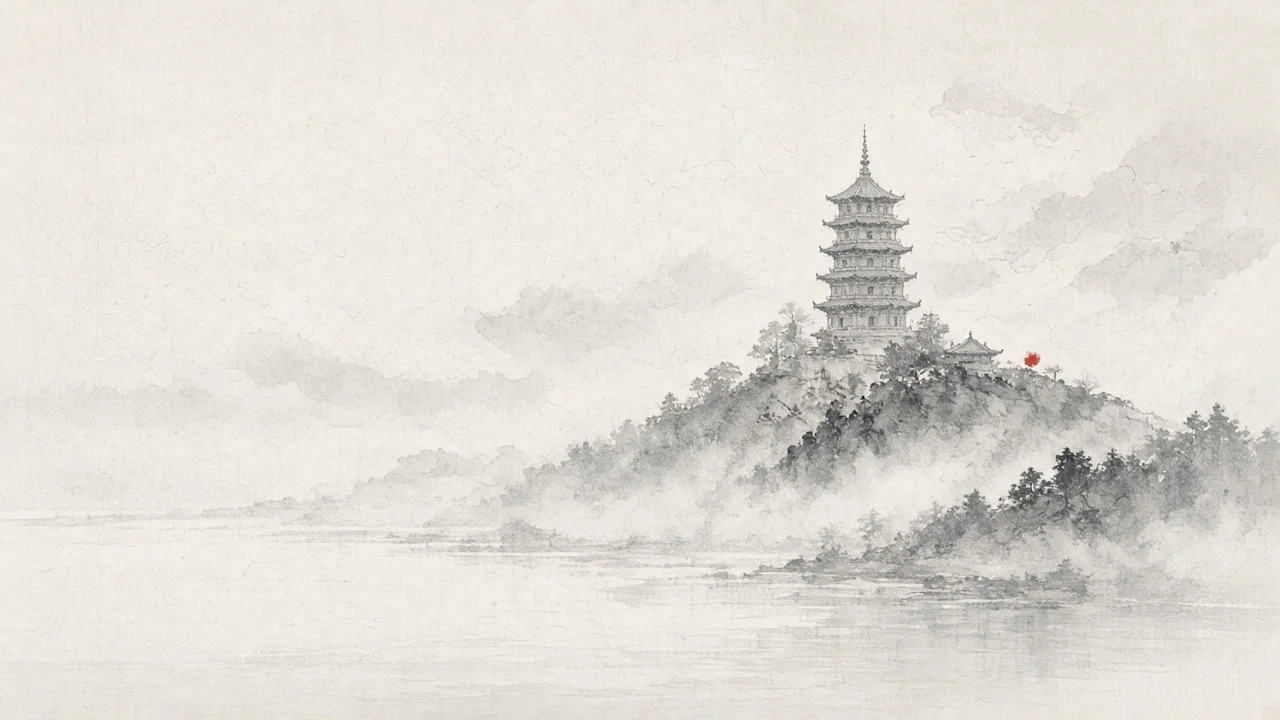
Langshan (狼山, Lángshān) south of Nantong is a low Yangtze-side hill crowned by Tang-era Guangjiao Temple, China's principal bodhimanda of Mahasthamaprapta Bodhisattva among the Eight Minor Buddhist Mountains — incense, forest paths, and Zhiyun Pagoda views over the river-sea confluence, not alpine drama. Climb for a compact half-day of Buddhist and riverside scenery.
What do you actually climb and see?
The path begins with smoke, not altitude. Shade, hall roofs stepped up the slope, then the river opening at the top. Guangjiao Temple (广教寺, Guǎngjiào Sì) is not one courtyard parked at a gate — halls sit at different heights, so the visit is the walk between them. At the summit, Zhiyun Pagoda (支云塔, Zhīyún Tǎ) is the vertical mark; the water in front is the river-sea confluence — Yangtze current widening toward coastal light — rather than a lake held in a high valley. A stairway and a cableway share the same short slope.
Why does a modest hill carry national Buddhist standing?
Five checkable facts keep the brochure from inflating the landform. Guangjiao Temple was founded in 669, the second year of the Tang Zongzhang era (总章二年). Langshan is China's principal bodhimanda of Mahasthamaprapta Bodhisattva (大势至菩萨, Dàshìzhì Púsà) among the Eight Minor Buddhist Mountains (佛教八小名山). Zhiyun Pagoda, raised in the Song, stands about 35 meters. The hill itself is about 107 meters high. The whole place sits roughly six kilometers south of downtown Nantong, in Chongchuan District (崇川区, Chóngchuān Qū), on the Yangtze's north bank.
That last pair is where fame argues with the ground. Religious standing is national; elevation is a riverside rise you can finish before lunch. Come for incense, tiled eaves, and a wide estuarine view from a short climb.
How is this different from Putuo or a high sacred peak?
This is the wrong mountain if you came for Putuo. The jade Guanyin pilgrimage attached to Mount Putuo does not sit on Langshan proper — the bodhisattva honored here is Mahasthamaprapta. Travelers who hear "mountain" and pack for switchbacks and thin air will feel sold a different trip. The reputation is earned; the elevation is not a secret, and the mismatch is how the visit goes sour.
When should you go, and how long?
Spring and autumn make the paths pleasant: March to May, and September to November. Late October is the foliage window. Give it a compact half-day — gate, stairs or cableway, halls, summit, and the walk back while light is still on the river. The cableway is sold separately from the gate ticket; both numbers move with the season and the notice board, so treat any fare you remember as already stale.
Hours, tickets, and how to get there?
As listed on the scenic area's pages at chinalangshan.com.cn (checked October 2026), the North Gate on Huayuan Road (花园路, Huāyuán Lù) is posted 7:00–16:30. The east gate on Chengshan Road (城山路, Chéngshān Lù) and the south gate on Shanshui Road (山水路, Shānshuǐ Lù) are posted 8:30–16:30 on that same page. The WeChat account 南通狼山森林公园 is where seasonal notices and the current ticket live — read it the week you go.
Nantong Metro Line 1 has no Langshan Station. The operator's Line 1 runs from Pingchao (平潮) to Zhenxing Road (振兴路); the published station list, checked October 2026, never takes the mountain's name. From downtown, a municipal outing note sends riders on Line 1 to Shiji Dadao Station (世纪大道站), Exit 1, then bus G1 or Tourist Route 2 (游2路) to the Langshan visitor center (狼山游客集散中心). Confirm that bus on the day. Bus sheets also name a Langshan Station — a bus stop about 400 meters from the east gate, not a subway platform.
Who is this for — and who should skip?
Come if you want incense, a Song pagoda, and estuary light from a short climb. Skip if you need a high sacred peak, a full day of wilderness walking, or Guanyin's island. Skip too if a Buddhist mountain is only a photo platform and the halls on the way down are an interruption.
More from Nantong
- history / 6 min readOn the Haohe River in Nantong, China's first public museum founded by Chinese people still shows a garden-campus of specimens, archaeology, and civic education — not a single star gallery.
- nature / 7 min readNantong's Haohe is a free daytime riverside loop around the old city — walk the banks first, and treat a lit night boat as optional, not the default.
- culture / 7 min readAt Nantong Blue Calico Museum on Haodong Road, indigo-resist printing is still a living craft — carved blocks, paste, dye vats, and white-on-blue cloth — not a souvenir-shop stop.