Ancestral Roots, Not an Old Tree: What the Hongdong Big Locust Tree Site Is For
The Hongdong Big Locust Tree Root-Seeking Park commemorates Ming-era migrations remembered by families across north China; it is a heritage park more than a botanical sight, best as a short stop paired with Guangsheng Temple.
Published
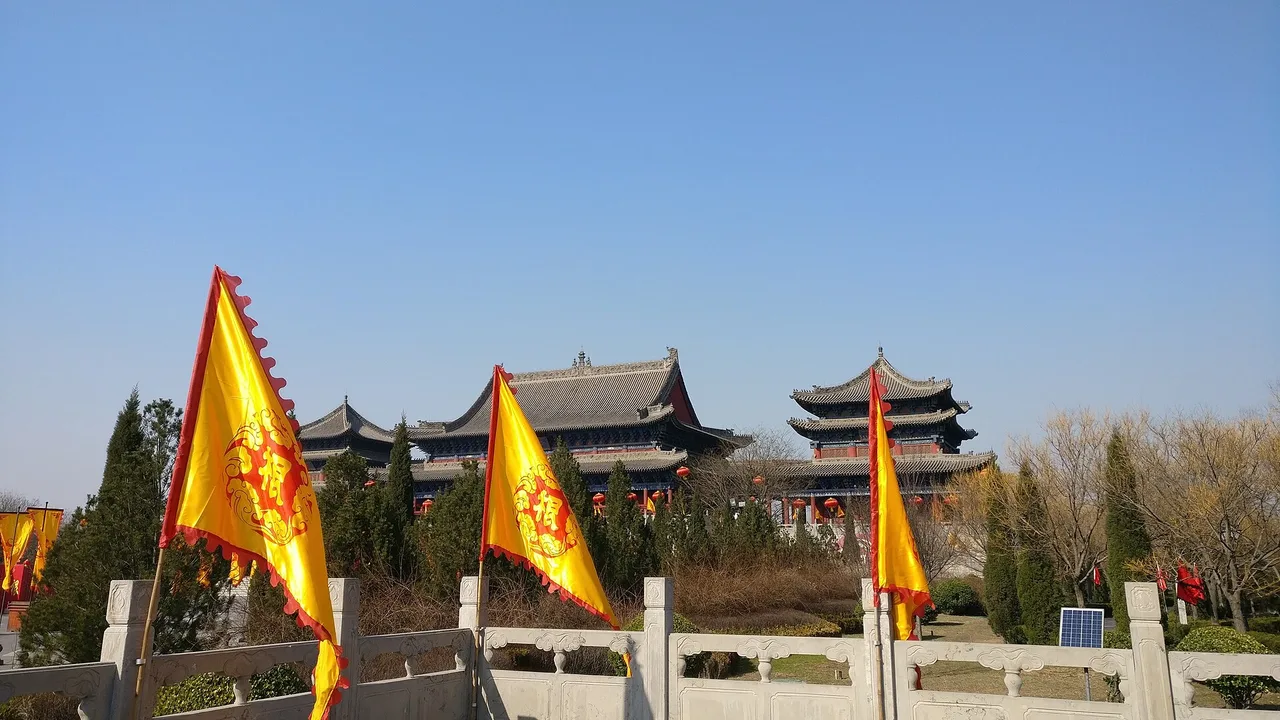
The Hongdong Big Locust Tree (洪洞大槐树) site is a memorial park, not a famous living tree. It marks the Ming-era migrations out of this part of Shanxi that many families across northern China still name as their origin. Come for that story, give it about two hours, and pair it with Guangsheng Temple the same day.
Why does a tree matter so much?
In the early Ming, after decades of war and disaster on the North China Plain, the state moved large numbers of people out of populous southern Shanxi to resettle emptier lands. Family memory placed the gathering point under a big locust tree at Hongdong. Over the centuries, a saying spread across Henan, Hebei, Shandong and beyond: ask where your ancestors came from, and the answer is the big locust tree at Hongdong. Historians debate the details, but the memory itself is what matters here.
The original tree is gone. What you see are later trees said to grow from it, plus memorial halls, a ritual ground, surname walls and exhibitions about the migrations. The ancestral rites associated with the site are listed as national intangible heritage.
What will a foreign visitor get out of it?
Honestly, less than a Chinese family with a Shandong or Henan surname who come to bow at their name. The park is well kept, but signage is mostly Chinese and the displays are built around descent and ritual rather than architecture. It works well if you are interested in how Chinese people remember origins, or if you travel with Chinese friends. If you want old buildings, Guangsheng Temple is the stronger stop.
If you go, watch a moment in the surname hall. Visitors search out their own character and photograph it, which says more about the place than any display board.
How do you fit it in?
It sits in Hongdong town, about 1.5 km from Hongdong station and about 8 km from Hongdong West high-speed station, a short taxi ride either way. That makes it an easy stop when you leave or join the train. A sensible half day is Guangsheng in the morning, when the light on the pagoda is good, then the Big Locust Tree after lunch, then a train back to Linfen or on to Taiyuan. For the bigger picture, see getting around Linfen without a car.
Tickets and hours — what should you check?
Checked October 2026 (Asia/Shanghai). The park's official mini-program and phone lines win over this page; the details below come from Linfen Bendibao's listing, not an official page.
Ticket. Listed at 80 yuan, with half price for students and visitors aged 60 to 64, and free entry for those 65 and over and children under 1.2 m.
Hours. Peak season (26 February to 24 November) 7:00–19:30; low season (25 November to 25 February) 7:30–18:00.
Phone. 0357-6658086.
Should you skip it?
If time is short and your interest is art, yes. If you have a free afternoon in Hongdong, or Chinese family roots of your own, it is a quiet, moving place to spend two hours.
Cover photo: Larry yang / Wikimedia Commons (CC BY-SA 4.0)
More from Linfen
- history / 4 min readLittle Western Heaven (Xiaoxitian) is a small Ming hillside temple whose main hall is crammed with gilded hanging sculpture; book a real-name ticket, give the hall most of your time, and allow a long day from Linfen.
- nature / 4 min readHukou Waterfall's Shanxi bank, in Ji county, now shares one 80-yuan ticket with the Shaanxi bank for two days; go in summer or autumn flow, arrive early, and expect a long road from Linfen.
- history / 4 min readGuangsheng Temple near Hongdong is two sites on one 70-yuan ticket: the Upper Temple's glazed Flying Rainbow Pagoda and the Lower Temple's Water God Temple with Yuan murals, including a famous theatre scene.