A Glazed Pagoda and a Wall of Yuan Theatre: Is Guangsheng Temple Worth the Detour?
Guangsheng Temple near Hongdong is two sites on one 70-yuan ticket: the Upper Temple's glazed Flying Rainbow Pagoda and the Lower Temple's Water God Temple with Yuan murals, including a famous theatre scene.
Published
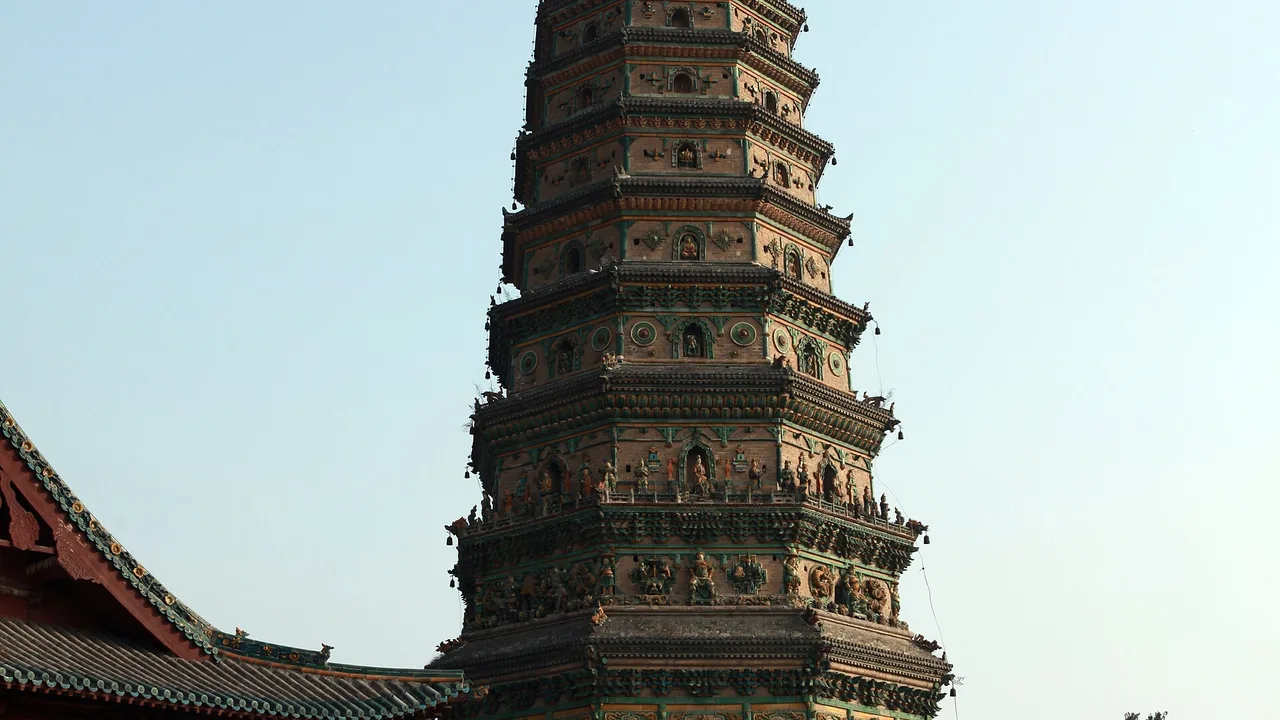
Yes, if you like old buildings and murals. Guangsheng Temple (广胜寺), under Huo Mountain north-east of Hongdong, is really two sites on one ticket: the Upper Temple, with the glazed-tile Flying Rainbow Pagoda, and the Lower Temple next to the Water God Temple, whose Yuan-dynasty murals include a rare scene of a theatre troupe.
What is in the Upper Temple?
The Upper Temple sits on the hillside. Its centrepiece is the Flying Rainbow Pagoda (飞虹塔), a tall octagonal brick pagoda faced in coloured glazed tiles: figures, animals and ornament in green, yellow and blue. Seen in sunlight, it is one of the most colourful old structures in northern China. Behind it are halls of Buddhist images, and the temple is also known for once holding the Zhaocheng Jin Tripitaka (赵城金藏), a twelfth-century printed Buddhist canon that is now held elsewhere.
Repairs were running in 2026. A scenic notice said phase-two conservation would run from 13 August to a planned finish on 20 October 2026, covering the Upper Temple's gate, festoon gate, side halls and meditation hall. The site stayed open, with hoarding around the work. Expect some scaffolding or fencing to linger after that date.
And the Lower Temple and Water God Temple?
Down the hill, beside the Huo spring, the Lower Temple has Yuan-era halls with the heavy timber frames this part of Shanxi is known for. Next door, the Water God Temple (水神庙) is the reason many specialists come: its main hall walls are painted with Yuan murals, and one panel shows a troupe of actors on stage, often cited as a rare early picture of Chinese theatre. Give that hall unhurried time. The light is dim, so let your eyes adjust.
How do you get round, and how long does it take?
From the visitor centre a scenic bus takes you to the Upper Temple, back down to the Lower Temple and the spring. Allow two to three hours for both. Guides are available for a fee, and help with the murals.
Guangsheng is about 17 km from Hongdong town, so most people come by taxi from Hongdong or Hongdong West station, or on a Linfen tourist coach when one runs. The easy pairing is the Big Locust Tree site in Hongdong the same day.
Tickets and hours — what should you check?
Checked October 2026 (Asia/Shanghai). The operator's own site (htgss.cn) and on-site notices win over this page.
Ticket. 70 yuan adult, one ticket for both temples. The operator lists half price for students, minors aged 6 to 18 and visitors aged 60 to 64, and free entry for those 65 and over and children 6 and under or 1.2 m and under. Note the age cut-off is 65 here, not 60. Concessions are exchanged at the window with ID.
Hours. Commonly listed as 8:00–18:30 in summer and 8:00–18:00 in winter; check the last entry time on the day.
Phone. 0357-5565533.
Who should skip it?
If you have just one day and your heart is set on hanging sculpture, go to Xiaoxitian instead. If you have already enjoyed the Yingxian Wooden Pagoda, though, Guangsheng gives you a second, very different pagoda and the best murals in the Linfen basin.
Cover photo: Artsxiang / Wikimedia Commons (CC BY-SA 3.0)
More from Linfen
- history / 4 min readLittle Western Heaven (Xiaoxitian) is a small Ming hillside temple whose main hall is crammed with gilded hanging sculpture; book a real-name ticket, give the hall most of your time, and allow a long day from Linfen.
- nature / 4 min readHukou Waterfall's Shanxi bank, in Ji county, now shares one 80-yuan ticket with the Shaanxi bank for two days; go in summer or autumn flow, arrive early, and expect a long road from Linfen.
- culture / 4 min readThe Hongdong Big Locust Tree Root-Seeking Park commemorates Ming-era migrations remembered by families across north China; it is a heritage park more than a botanical sight, best as a short stop paired with Guangsheng Temple.